About the Man
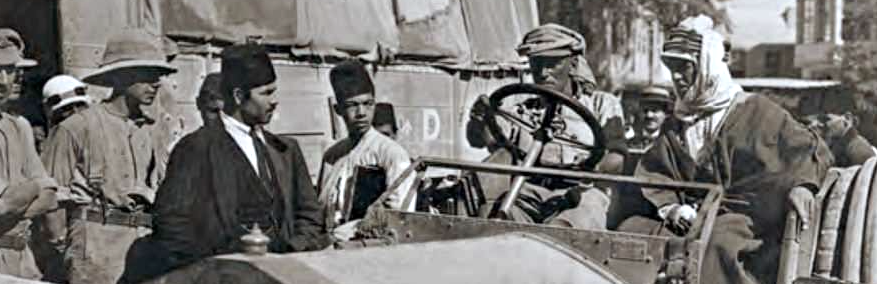
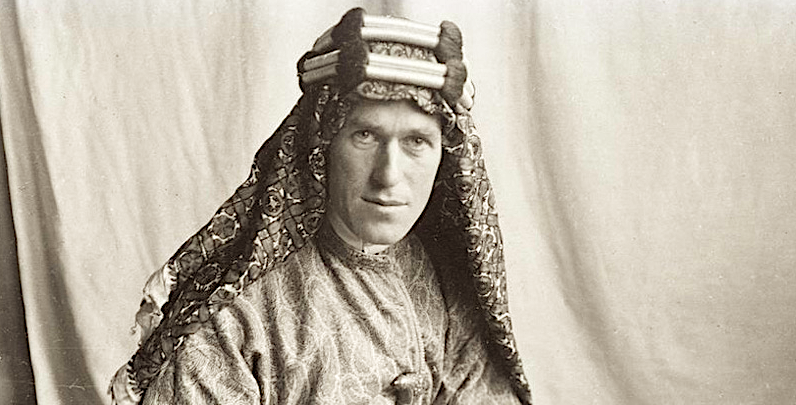
Sporting a British Army uniform in the rank of Colonel, he topped the attire off with a keffiyeh. He was there in support of Feisal as his Aid.
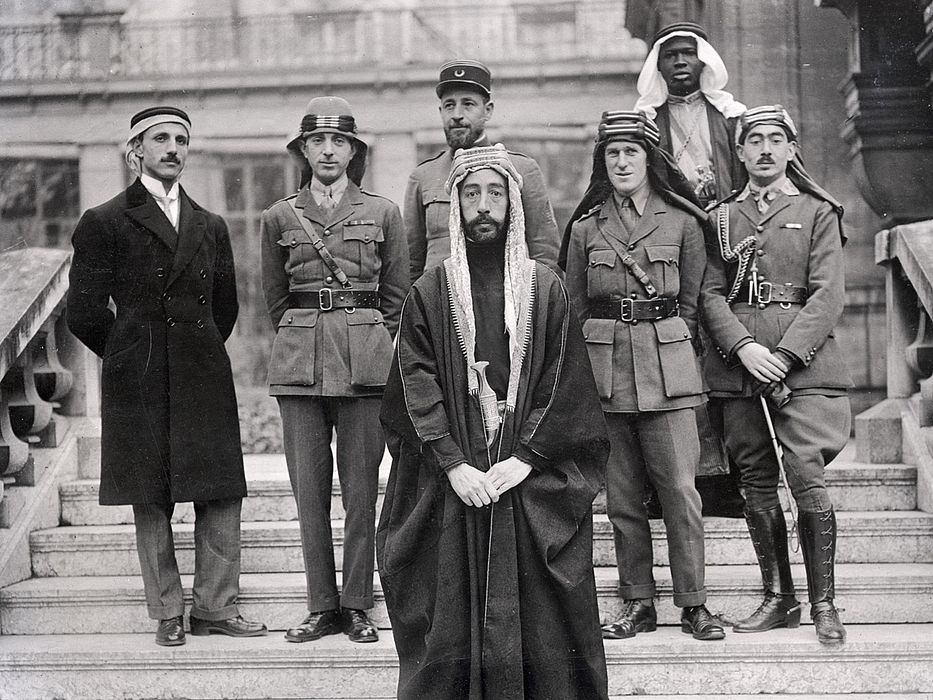
Feisal's entourage at Paris
© IWM
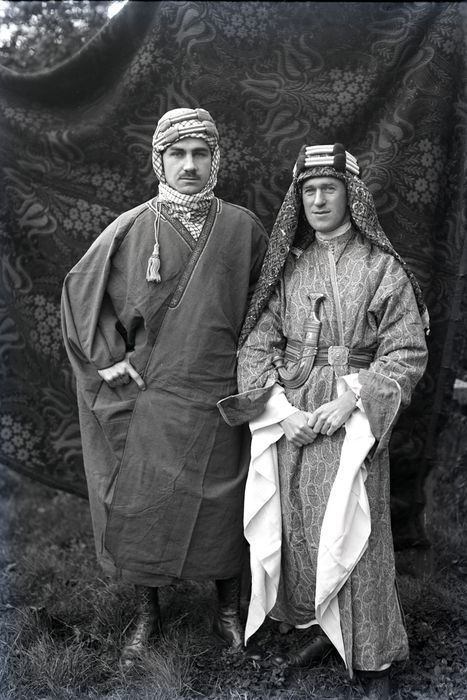
Lowell Thomas with Lawrence in Arab dress.
On arrival in Jerusalem he recalls in his book, 'With Lawrence in Arabia' the following.
One day not long after Allenby had captured Jerusalem, I happened to be in front of a bazaar stall on Christian Street, remonstrating with a fat old Turkish shop-keeper who was attempting to relieve me of twenty piastres for a handful of dates. My attention was suddenly drawn to a group of Arabs walking in the direction of the Damascus Gate. The fact that they were Arabs was not what caused me to drop my tirade against the high cost of dates, for Palestine, as all men know, is inhabited by a far greater number of Arabs than Jews. My curiosity was excited by a single Bedouin, who stood out in sharp relief from all his companions. He was wearing an agal, kufheh, and abba such as are worn only by Near Eastern potentates. In his belt was fastened the short curved sword of a prince of Mecca, insignia worn by descendants of the Prophet.
He continues..
It was not merely his costume, nor yet the dignity with which he carried his five feet three, marking him every inch a king or perhaps a caliph in disguise who had "stepped out of the pages of The Arabian Nights." The striking fact was that this mysterious prince of Mecca looked no more like a son of Ishmael than an Abyssinian looks like one of Stefansson's red-haired Esquimaux.
Finally he asks Ronald Storrs now the Military Governor in Jerusalem…
“Who is this blue-eyed, fair-haired fellow wandering about the bazaars wearing the curved sword of a prince of ——?
The general did not even let me finish the question but quietly opened the door of an adjoining room. There, seated at the same table where von Falkenhayn had worked out his unsuccessful plan for defeating Allenby, was the Bedouin prince, deeply absorbed in a ponderous tome on archaeology.
In introducing us the Governor said, 'I want you to meet Colonel Lawrence, the uncrowned King of Arabia.'
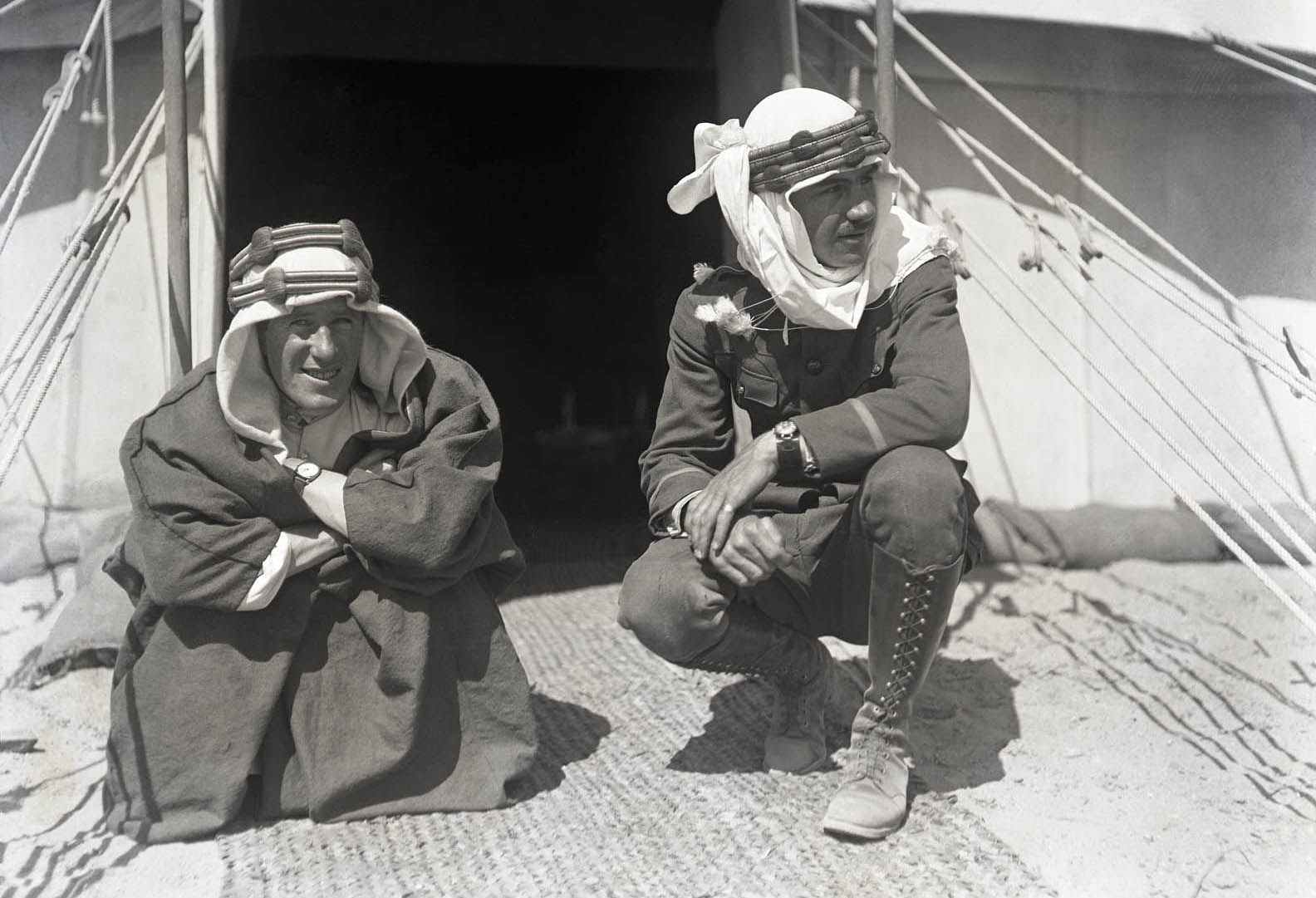
Lawrence and Thomas in Arabia.
As part of his journey and possibly to write his history of events he set to to finish The Seven Pillars of Wisdom.
His private life was, and still is today, subject to scrutiny but my thoughts are simply that he was just an old fashioned confirmed batchelor. The things he did and suffered during the war years may well have had adverse effects on him, and had he lived who knows how his life would have panned out.
Changing his name, which his father did, and joining the RAF was part of his way of withdrawing from the limelight. Rank appeared to hold no kudos for him. The RAF was merely a 'vehicle' which allowed him to have structure in his life and an income. The bonus for him was it allowed his interest in engineering to flourish.
In a letter, shortly before Lawrence retired from the RAF, he wrote to John Buchan.
Bridlington,
Yorkshire
20.XII.34
Dear J.B.,
You'll wonder why on earth I write, and what I now want. Answer - only to tell you that my R.A.F. twelve-year engagement is within a few weeks of running out. I have not tried to extend for 24 years, because my age then would make me a ludicrous airman, even if I lived the whole twelve more. But if I could have remained perpetually young, nothing would have pleased me better.
If you meet Mr Baldwin in the near future, will you please tell him that the return to the Air Force secured me by him (on your initiation) has given me the only really contented years of my life? Please say that I've worked (and played) all the time like a trooper: that my spell of service has been spent in doing my best to raise the pride and respect of the ranks, and to make them pleased with their duties: that amongst my jobs have been a reorganisation of aero-engine overhauls in India, the ground-work for the 1929 Schneider Cup, and lately the development of the marine-craft side of the R.A.F. In four or five years we have trebled the speed and yet reduced the prime cost and running cost of all the R.A.F. boats: and now the War Office and the Admiralty are borrowing our boats and copying or adapting our designs for their purposes.
I tell you all this not to boast of it, but to show that you and Baldwin, in gratifying what may have seemed to you my indulgence, have not harmed the public service. I have done all I could, always: and could have done far more, if they had given me more rope. The Air Force is pretty good, down below. I think it deserves more imaginative handling than it gets.
However this note (meant to be a paean of gratitude to two admirable men) mustn't descend into politics. I owe the two of you more than my twelve years work (and another twelve on top of it, were I young enough) in the sheer satisfaction it has been. You have me very hopelessly in your debt: and thank you both very much for it.
Yours sincerely
T E Shaw
*John Buchan the author of The 39 Steps, Greenmantle etc., was a high ranking Intelligence Officer during WW1 reporting directly to the Prime Minister and was shortly after this letter from Lawrence, raised to the peerage, to become the Governor General of Canada, acknowledged by Lawrence in a later letter.