About
About the site & Author
The main aim of this website is to map the journeys made by T. E. Lawrence. There are tomes of work, both in print and on the WWW, that have been written by people with greater knowledge than myself on the life of Lawrence. In the process of research it was necessary to compile my own notes and findings. Rather than let these disappear into a digital graveyard, I though they may provide a vehicle for my maps and maybe provide another view on a man who was undoubtably an outstanding man of his times.
The process of putting data into meaningful maps has not been without its challenges. Variations in place names, dates in diaries, notes that do not quite match have all contributed to a fascinating journey for myself if not frustrating at times. That journey continues and while I've only covered one journey in part, so far, the others are very much shorter and I am more familiar with the geographical detail and names than I was 2 years ago.
One area I thought may be interesting to further are my findings on those people associated with Lawrence throughout his life. Many of whom lead just an adventurous existence as Lawrence but were not subject to the exposure provided by the American journalist, Lowell Thomas, in his roadshow about Lawrence's time in Arabia.
The site will be in a constant state of being updated for a while as I add more information.
The process of putting data into meaningful maps has not been without its challenges. Variations in place names, dates in diaries, notes that do not quite match have all contributed to a fascinating journey for myself if not frustrating at times. That journey continues and while I've only covered one journey in part, so far, the others are very much shorter and I am more familiar with the geographical detail and names than I was 2 years ago.
One area I thought may be interesting to further are my findings on those people associated with Lawrence throughout his life. Many of whom lead just an adventurous existence as Lawrence but were not subject to the exposure provided by the American journalist, Lowell Thomas, in his roadshow about Lawrence's time in Arabia.
The site will be in a constant state of being updated for a while as I add more information.
All my research references can be found on the Reference page. It spans books, websites, library material, film/video and details of what were Top Secret Documents now in the Public Domain by courtesy of a collaboration between The British Library and the Qatar National Library.
Cookies
Please note this site does not use Cookies. The only links to Google are for typeface fonts. The server is hosted by UK2Net in the UK. Any external links are given in good faith and link to subject matter related to this site's content.
Read more..
David Lean's Film
The film 'Lawrence of Arabia' was and still is the most likely way people find out about TEL.
All I'm going to say about the film is this:
All I'm going to say about the film is this:
- It is unquestionably an outstanding piece of cinematography.
- The casting was superb by all the lead roles.
- It remains my 'all time greatest movie!'
- I wasn't going to include this bit but hey!
Connection with Lawrence?
My interest in Lawrence has spanned some sixty years but it is only in the last few years that I've taken a deeper interest.
It all began when my father gave me a second hand copy of 'Lawrence and the Arabs' by Robert Graves, Children's Edition, as a stocking filler at Christmas! Not long after I was taken to the Belgrade Theatre in Coventry to see Terence Rattigan's play 'Ross'. Much to my mother's horror I seem to remember but father insisted.
The next milestone was David Lean's epic film, which I only saw because my father knew the cinema manager, not being old enough for the film's rating at the time. It was at this point that a possible family association with Lawrence surfaced.
The opening sequence of the film shows Lawrence preparing to ride his motorcycle, which would lead to his untimely death. As the frames rolled the make of the motorcycle became more obvious, my father appeared to become agitated as to the accuracy of the bike's model. "That's not right" he said aloud, with the surrounding audience replying with "Shhhhhhsh!" After the film or it could have been in the intermission, I asked him what was wrong. "Grandad Neville knew Lawrence." That's all I got and it was never mentioned again. Some years later I must have mentioned it to Mum. She was vague and said she thought it was to do with motorcycles but wasn't sure.
It all began when my father gave me a second hand copy of 'Lawrence and the Arabs' by Robert Graves, Children's Edition, as a stocking filler at Christmas! Not long after I was taken to the Belgrade Theatre in Coventry to see Terence Rattigan's play 'Ross'. Much to my mother's horror I seem to remember but father insisted.
The next milestone was David Lean's epic film, which I only saw because my father knew the cinema manager, not being old enough for the film's rating at the time. It was at this point that a possible family association with Lawrence surfaced.
The opening sequence of the film shows Lawrence preparing to ride his motorcycle, which would lead to his untimely death. As the frames rolled the make of the motorcycle became more obvious, my father appeared to become agitated as to the accuracy of the bike's model. "That's not right" he said aloud, with the surrounding audience replying with "Shhhhhhsh!" After the film or it could have been in the intermission, I asked him what was wrong. "Grandad Neville knew Lawrence." That's all I got and it was never mentioned again. Some years later I must have mentioned it to Mum. She was vague and said she thought it was to do with motorcycles but wasn't sure.
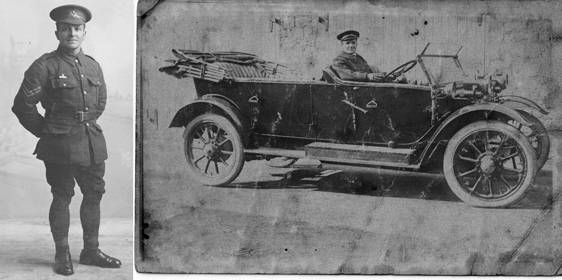
James Gladstone Neville
Grandad Neville died the same year as Lawrence, my father being 15 at the time. Grandad had served in the Navy as a Steward pre WW1 and left to join the Territorials before the war. He served in the South Nottinghamshire Hussars, first at Gallipoli and then Egypt, possibly Palestine. However in the final year of the war his unit was re-mustered along with the Warwickshire Yeomanry to form a Machine Gun Corps.
Their destination was to be the Western Front for the last big push.
Fate however was to delay their passage. The troop ship 'Leasowe Castle' just hours out of Alexandria bound for Marsailles, was struck by a torpedo from a German U-Boat. The ship went down but he survived only to be on the next troop ship bound northward!
Finding out details has not been easy as many WW1 service records were burnt in bombing raids on London during WW2.
I have managed through photos and other family documents to find out that at the beginning of 1917, he managed to get back to London and marry my Grandmother. The marriage certificate quite clearly states his occupation as 'Motor Driver, S. Notts Hussars'. He must have returned to Egypt soon after.
Families can be funny-odd affairs and neither Gran or Dad spoke about those times. The only time I found anything out was concerning a lovely copper ewer which Gran passed on to me saying that Grandad had picked it up from the beach at Gallipoli during the retreat. How many of us can look back now and say why didn't I ask!
I do know that my Grandparents lived near Gran's family in the Nottingham area for awhile after the war before moving to Cheshire. The Brough Motorcycle works were of course not far from them, so if there was an association to Lawrence then that could possibly be it. Granda was mechanically proficient and worked sometimes as a chauffeur. Lawrence while at Cranwell used to make regular trips out on his Brough often calling at the works.
Their destination was to be the Western Front for the last big push.
Fate however was to delay their passage. The troop ship 'Leasowe Castle' just hours out of Alexandria bound for Marsailles, was struck by a torpedo from a German U-Boat. The ship went down but he survived only to be on the next troop ship bound northward!
Finding out details has not been easy as many WW1 service records were burnt in bombing raids on London during WW2.
I have managed through photos and other family documents to find out that at the beginning of 1917, he managed to get back to London and marry my Grandmother. The marriage certificate quite clearly states his occupation as 'Motor Driver, S. Notts Hussars'. He must have returned to Egypt soon after.
Families can be funny-odd affairs and neither Gran or Dad spoke about those times. The only time I found anything out was concerning a lovely copper ewer which Gran passed on to me saying that Grandad had picked it up from the beach at Gallipoli during the retreat. How many of us can look back now and say why didn't I ask!
I do know that my Grandparents lived near Gran's family in the Nottingham area for awhile after the war before moving to Cheshire. The Brough Motorcycle works were of course not far from them, so if there was an association to Lawrence then that could possibly be it. Granda was mechanically proficient and worked sometimes as a chauffeur. Lawrence while at Cranwell used to make regular trips out on his Brough often calling at the works.
Read more..
Site Navigation
Icons have become a popular method of website navigation. Hope the layout and icons/text that expand giving more information are intuitive. The main page navigation is handled by the "hamburger stack" at the top right of all pages. Here are others used on this site.

Open Read more..

Close Read more..

Open information

Close information
Future Projects
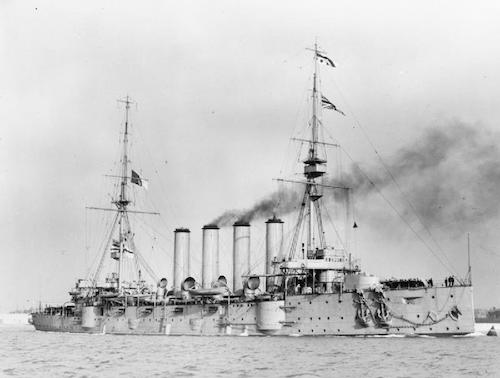
H.M.S. Euryalus was the Flagship of the Royal Navy's Red Sea Patrol. This fleet of ageing naval and merchant shipping were instrumental in the success of the engagements by the British Allied Army, Lawrence and the Arab Revolt against the Turkish forces.
As crazy as it may seem for the time they also provided air power to the region. Seaplanes were craned off their deck for reconnaissance and bombing raids.
The ships also provided seaborne artillery, being very effective at the start of the Arab Revolt in keeping the Turks at a distance, allowing the Arabs to re-muster.
Earlier in the war they were used on the Suez Canal, once again keeping the Turks at a distance in Sinai and preventing them taking Cairo.
The ships also provided seaborne artillery, being very effective at the start of the Arab Revolt in keeping the Turks at a distance, allowing the Arabs to re-muster.
Earlier in the war they were used on the Suez Canal, once again keeping the Turks at a distance in Sinai and preventing them taking Cairo.
There is an interesting feature in the picture of H.M.S. Euryalus. You can see two half cylindrical structures attached to the ships hull. These are known as casemates. They house the ship's gunshot you will come across the term in Lawrence's writings, a favourite place to retire too out of the way.
Read more..
Old Maps
I have recently procured a copy of 'Captain Shakespear's Last Journey' by Douglas Carruthers in 1922, on behalf of the Royal Geographical Society.
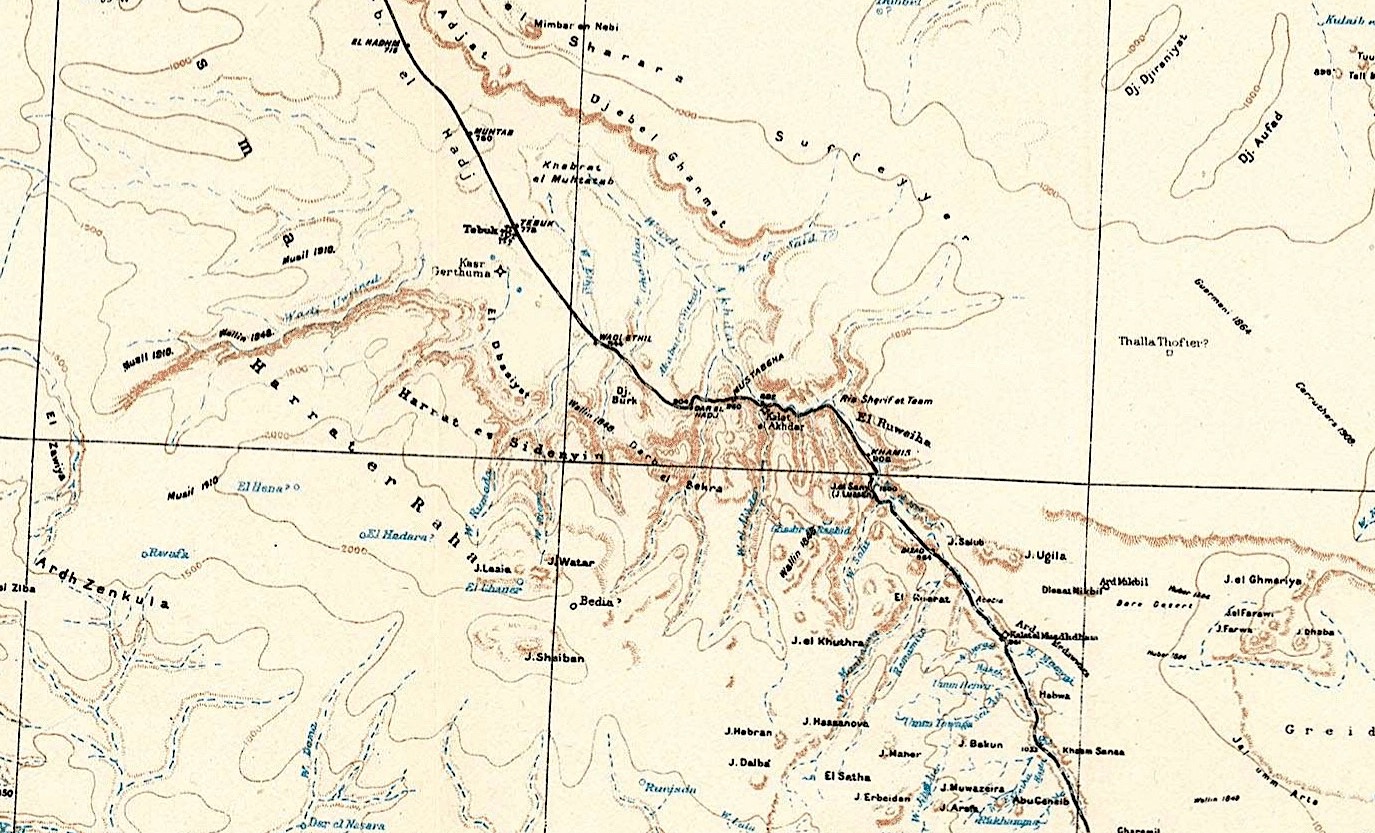
It has with it a map, which includes the Hedjaz and as far north as Amman. I am hoping to be able to georeference the map against satellite imagery.
It has with it a map, which includes the Hedjaz and as far north as Amman. I am hoping to be able to georeference the map against satellite imagery.
Captain William Henry Irvine Shakespear is one of the less well known individuals who preceded Lawrence in secret behind the scenes negotiations with the Arab Nations, just before and at the beginning of the outbreak of WW1.
He came from an established military family and before the war had become an accomplished explorer and adventurer.
While Lawrence was enroute to the Arab Bureau in Cairo with Captain Newcombe, Captain Shakespear was embarking on a secret mission to meet up with Ibn Sa'ud to offer him a treaty of alliance with the British Government. He left Kuwait on 12th December 1914, Lawrence arrived in Cairo on 15th December 1914.
He came from an established military family and before the war had become an accomplished explorer and adventurer.
While Lawrence was enroute to the Arab Bureau in Cairo with Captain Newcombe, Captain Shakespear was embarking on a secret mission to meet up with Ibn Sa'ud to offer him a treaty of alliance with the British Government. He left Kuwait on 12th December 1914, Lawrence arrived in Cairo on 15th December 1914.
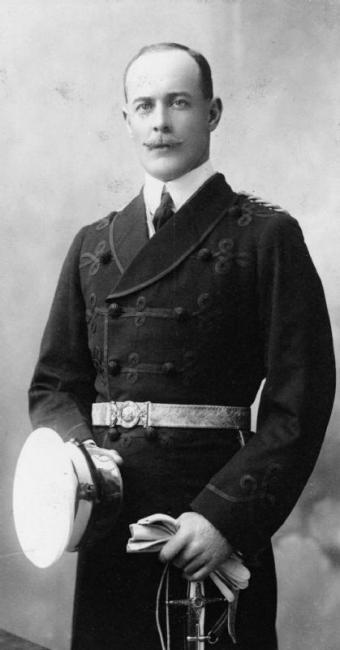
Shakespear reached Ibn Sa'ud's camp after a 330 mile journey across the desert taking nineteen days. On 4th January 1915 Shakespear wrote a letter to Sir Percy Cox, informing him the mission had been a success, enclosing a translation of the treaty agreement between himself and Ibn Sa'ud.
Shakespear decided to remain with Ibn Sa'ud under a spirit of friendship which the two men had formed and accompanied Ibn Sa'ud on an expedition against the Bani Shammar tribe, who were loyal to Ibn Sa'us's enemy, Ibn Rashid.
On 24th January 1915 the two forces met near Jarrab. The battle resulted in Shakespear's death. While not actively engaged in the fighting he had set himself up on nearby raised ground to view the action. There were conflicting reports on how he was killed. I shall include more about Shakespear on the Movers & Shakers page.
You can read an excellent account on the Qatar National Library website. Daniel A Lowe: The Death of Captain Shakespear.
Shakespear decided to remain with Ibn Sa'ud under a spirit of friendship which the two men had formed and accompanied Ibn Sa'ud on an expedition against the Bani Shammar tribe, who were loyal to Ibn Sa'us's enemy, Ibn Rashid.
On 24th January 1915 the two forces met near Jarrab. The battle resulted in Shakespear's death. While not actively engaged in the fighting he had set himself up on nearby raised ground to view the action. There were conflicting reports on how he was killed. I shall include more about Shakespear on the Movers & Shakers page.
You can read an excellent account on the Qatar National Library website. Daniel A Lowe: The Death of Captain Shakespear.
Read more..