Image

An old friend, who’s a bit of an amateur historian, and at times a touch indelicate, suggested in a pub in Earls Court one night that at my ripe old age, I should jot down some memories of growing up in the thirties, and the war etc. Adding that memories like these were invaluable for future generations and historians like him, as once I’ve kicked the bucket, they’re gone, forever!
When over the kicking the bucket bit, conceded that he was possibly right. If only for my three daughters and future family.

When thinking about it, could be like adding a bit of hitherto unknown social history to that bumper book of the past, never put in writing before! They say the written word is set in stone! Could last for thousands of years! You never know, the name Roger Murray could pop up like another Plato or Herodotus in years to come. Hmm, quite like the idea!


I was born on the 24th of April 1930 in St Mary’s Hospital, Manchester, in the County of Lancashire, England.
Only a duck stride from the Bridgewater canal. In fact the canal was just on the other side the hospital ward wall where I was actually born. Maybe some canal water could have accidentally got into the blood at birth, as the hospital plumbing in those days left a bit to be desired. As the canals and boats became a big part of my life in later years.
Understand I was bit premature. My mother reckoned that she had a hard time delivering me and that I came out a yellowish tinge! ´Yellowish!´ Thank god it was only to do with this craving thing pregnant ladies have. My mothers was for oranges, lots of them!
So on the 24th of April 1930 a yellowish Roger Garth Murray enters this big wide world.
My parents were only in Manchester for short time, think about three or four years before moving South to London, so can remember very little about it except vague recollections of a garden full of runner beans and wooden railings at the end with steam trains chuffing past. Also, being in a pram with a big dog licking my face.
That was the memory of Manchester. All of it! But proud to have been born in that great northern city. Thus a true Mancunian!

My father was a down to earth Lancashire lad from Ashton under Lyne, near Manchester and had spent his apprenticeship working on railway locomotives at Gorton, an industrial part of the city. Studying profusely at night school in his twenties he then came out of overalls and into a suit, working at the colour printers Norbury Natzio. Having a bit of a creative eye, he was something to do with colour and design at the printers.
My mother on the other hand was a bit cut glass from the South, hating the heathen North, as she put it. So it wasn’t long before we all moved South to London. She was obviously the driving force!
I vaguely remember that long and slow journey South, sitting in the back of the family saloon car, think it was an Austin ten.
Of course cars were not thoughtful enough to have heaters in those days, so it was tartan rugs over our knees and lots of stops for hot Heinz tomato soup out of a thermos flask and tepid sweet Camp coffee made with lots of milk out of the other.

Also numerous sick stops as the cars foggy interior together with the sweetish smell of its leather seats, just made me feel sick. Not forgetting on one sick stop, Tipsy our cat escaping and running off through the hedgerows, with my dad ankle deep in a muddy field trying to enticing her back. Yes, we took the cat to London!

Still have memories of going through a dark and most satanic place on that journey south. The sky nearly going pitch black with billowing clouds of smoke over a stark industrial landscape dotted with odd shaped looking buildings with smoking chimneys and what seemed to be raging fires. Had a strange inner excitement by it all!
It was the Potteries in the thirties.


We lived at first in Upper Berkeley Street, London. Just at the back of Marble Arch.
Everywhere seemed so busy and intense compared to suburban Manchester. I think it was sheer the hustle, bustle and energy of the place. I was especially intrigued by the big red double decker buses, dozens of them up and down Oxford Street just round the corner at the end of the street. Think the red double decker buses were my first symbolic impression of the place.
The first truly likeable impression, especially as a child, was the Walls Ice Cream (‘Stop Me And Buy One.’) men pedalling round the streets on their three wheeled bikes. They were everywhere, and I just loved their Snow fruit lollies.
Seemed to spend a lot of time being pushed in a little buggy round Hyde Park looking at ducks and things, and also watching model sailing yachts racing on the Round Pond at the back of Kensington Palace
Got a bit too inquisitive once. Tripped and fell on top of one of the precious model yacht. Causing one big a row. Had evidently broken something on its flimsy mast, with its owner all dressed up in straw boater and striped blazer jumping up and down in a frenzy, shouting at my poor mother. Soon to be surround by all the other straw hat and striped blazer pond yachties, all looking extremely serious. Dispersed by a kindly London policeman, or he might have been a park keeper, anyway he had a uniform on, and a big moustache, who patted me on the head telling me not to cry. Evidently the model yacht I’d fallen on was the star performer of the pond fleet and I’d put paid to the main race of the day!

We didn’t have supermarkets and such in those days. Seem to remember that Sainsbury’s were in existence with big grocery shops, but the one we frequented was called ‘Home and Colonial.’ They were all over the place and what wonderful grocery emporiums they were! Everything shone! Even the beautifully tiled floors, rich mahogany counters topped with marble, and the polished brass tills. There were hams, cheeses and all kinds of delectable things all beautifully displayed behind curved glass display units. All the male assistants wore spotless white aprons bow ties and straw boaters. If say you wanted butter, they would take a slice from a big barrel and with two wooden pats, pat it into shape to the desired size, then wrap it in special Home and Colonial grease proof paper. Always remember this paper as it had an engraved print showing Queen Victoria at its centre with the flags of all the nations of the then British Empire. I knew them all off by heart.
Then there were the Lyons Corner houses. My mother had a penchant for these. Can still picture their white frontage with the gilt lettering, J Lyons & Co Ltd. They were everywhere in London. In fact they were London! Hard to believe they could just vanish like that!
For some reason in my young mind they had something to do with Lions, so it created a certain liking!
They had the most mouth watering strawberry tarts topped with cream. That was my main memory. We always seemed to pop into the one at Marble Arch as my mother liked the strawberry tarts as well.
I think she was a bit lonely with knowing nobody in London and with my dad at the time working away, so we seemed to be continuously exploring on those big red double decker buses, which suited me.
With me always insisting on sitting upstairs at the front! They used to lean a lot on corners and I always had a fear of the thing falling over. Notwithstanding that I got to know London pretty well at a young age. Always had a fear of going over Tower Bridge with visions of it opening when we were in the middle. Reckon was a bit of a wimp.


On looking back, my favourite place in that big city was The London Zoo! I was enthralled

Think was a bit older when had the first London Underground railway experience, or the Tube as they called it later on.
That really was something! Think it was a Piccadilly. Going on those precarious looking escalators deep down into the bowels of the earth, down and down and then to discover an actual railway station right down there, and hearing a strange rattling sound, getting louder and louder, accompanied by a warm wind blasting out of a big back hole at the end of the platform, then with this red monster suddenly bursting out and charging to a stop only feet away, right in front of my very eyes. Was just too much. Evidently bawled my head off, throwing a tantrum and absolutely refusing to get on the thing!

Milk was delivered every morning by horse and cart, including a vegetable seller with horse and cart, even one which came round every week with stone flagons of the fizzy drinks of Sarsparella and Dandelion and Burdock.
Horses and carts were everywhere, especially those big horses with furry hoofs with their slow clip clop sound hauling heavy wooden wagons loaded to the sky with goods.
In fact, in those days horse drawn traffic seemed to still occupy lot of the traffic on those heavily congested streets of London.

Where we were in Upper Berkeley Street, we could just hear the comforting chimes of Big Ben on quiet nights. Even to this day the sound of Big Ben brings a kind of inner warmth and comfort.
It really was a Mary Poppins London in those days, not forgetting those cold foggy nights with the gas lit lampposts offering little pools of warm comforting light. A lamplighter man use to come round at night riding a bike to light each individual one with a long pole.
When the road was up for repairs they always had a night watchman who sat in a kind of little sentry box in front of glowing red hot fire in a brazier.
I got to know one watchman and used to sit chatting with him on many a night in front of that wondrous cosy fire. He was an ex soldier, wounded in the first world war and you could still feel bits of shrapnel in his heavily tattooed forearm. He used to sit there proudly wearing all his medals which used to glitter with the flickering of the fire. A real cockney from the East End and a most interesting man. I used to sit for hours full of intrigue just listening to his stories. Whenever I see and hear Michael Cain on the box, his cockney voice and accent takes me straight back to that dear old night watchman. They don’t make them like that any more.

Then there were the big stores like Selfridges just round the corner on Oxford Street, Harrods, and Gamages down in Holborn, which had a stupendous toy department. They were absolute wonderlands to my young eyes. Remember one store had a pets corner with real baby tiger cubs. Remember crying my eyes out wanting one.
I think those early childhood memories of that great ancient city left an indelible mark in the mind, hence always a lingering affection for the place. In fact, to this day I need London fix!


My parents had bought a shop near Croydon Airport. Croydon being Londons main airport before todays sprawling Heathrow. Strangely, the shop apart from selling cigarettes and tobacco was mainly a lending library where customers could rent a book or popular novel for a week. Remember, no television or internet for entertainment in those far off days! So lending library shops were popular. We also had the kiosk in the main Croydon airport building, selling tobacco, confectionary, newspapers and magazines etc, to the passengers flying to Paris on the then Imperial Airways big two winged giant Handley Page passenger aircraft, which always looked as if they were made of corrugated aluminium. They were massive cumbersome looking things which seemed to slowly lumber off down the runway like some giant pre historic bird, seemingly never to get off the ground or airborne until the very last minute. They even had a flag etiquette, with a little union flag on a tiny flagpole on the nose of the aircraft, with the pilot reaching out of his cockpit window to raise it once the aircraft was at a standstill on the apron, or to lower it before taking off.

Croydon was very different from the sedate Upper Berkeley Street.
I soon became part of a gang of local lads who used to mimic my Northern accent. We were a cruel lot when I think back. At the local pond there were lots of toads, we did the most awful things to the poor little creatures. Think a cruel streak is evident in most young boys, as now feel so appalled and guilty when thinking back. We would make battleships out of planks of wood from some fencing, with the superstructure made from modelled lumps of clay. Spent hours lobbing stones at them in sea battles.
We all had prized push carts made from a plank of wood on old pram wheels, with a box at the back end for sitting in. Steered by the feet on a moveable cross plank with wheels. Difficult to explain the exact design as they came in all shapes and sizes according to the lad or dad who built them. Of course it was all very competitive, re which was the fastest, also depending on the energy of the pusher. There was always severe competition on the question of speed. At the nearby Shirley Hills, there was a steep downhill winding road which seemed to go on and on forever.
This was our Brands Hatch as we used to have the most hair raising races down this long downhill road, reaching speeds (We thought) of well over thirty miles per hour! Sometimes even overtaking cars, and certainly putting the wind up drivers coming toward us.
I remember slicing the front wing off of a cherished and very shiny black Hillman Minx car with its bespectacled driver throwing tantrums, and my not very happy dad having to pay for it to be repaired. My prized speed machine duly confiscated. Finishing up on the fire used to heat the water for my mothers dolly tub. There were no washing machines in those days so my mother had a big tub in the back garden with a thing called a dolly she used to squelch the washing around with.

I think the most significant thing I can remember about moving to Croydon was the burning down of the Crystal Palace. The famous exhibition centre, the brain child of the Prince Albert which was first used for the great world exhibition of 1851 in Hyde Park.
Re located to upper Norwood in 1854. It was a wonder of the world, this magnificent massive glass palace which could be clearly seen from where we lived, sitting proudly on the hill to the North of us.
My parents took me to a dinosaur exhibition there in 1935 and can remember been totally knocked out by the tremendous size and presence of the place with tall full grown trees actually growing inside the building. It was only a year later we watched in awe as this wonderful fairy tale palace was burnt to the ground. So clearly seen from where we lived. The whole sky lit up with the red glow, and we could even hear the exploding of the thousands of glass panels as the fire took hold, this together with the ringing bells of virtually every fire engine in the area rushing to the scene. These memories remain as an immovable page in my mind.
The only recognisable thing left was the two proud glass towers which stood at either end of that once iconic building. People were openly crying.


There seemed to be a lot of simple minded and deformed people on the streets as there were no care homes or national health facilities in those days.
We had a Rag and Bone man who used come round the streets with his horse and cart, called Jimmy. Think he was a bit simple as we used to commandeer both he and his cart and go charging round the streets with Jimmy just sitting chuckling to himself. All he seemed to do was chuckle. It seemed that most of his customers with knowing Jimmy just loaded their unwanted things on to his cart and his dad sorted it all out on his return.
There was one poor man, locally known as ‘Big Head.’ As he had an enormous sized head and a club foot. You could hear him coming with his continual muttering to himself
and the pronounced slurring sound of his boot on the pavement, always begging for a cigarette. Then there was little Ernie, always with a enormous flat cap pushing his big ears out. and in an oversized raincoat reaching right down to his boots, who just smiled all the time, a bit like an adult Dopey in Snow White and the Seven Dwarfs. We made him an honorary member of the gang, and were his protectors from rival gangs. There were quite a few poor unfortunate people like this about and we did little to help them. The most pitiful of all was an enormously fat old woman called Big Doris who never spoke a word and sat all day, and night under some railway arches in what appeared to be a dozen or so oversize old overcoats. She just sat through all weathers, quietly begging. You could smell her a mile off with the stink of urine. They were raw days.

We used the tram a lot. They were painfully slow and would shake, clatter and clank along the track. All the seats were wooden slatted and hard. When reaching a terminus all the seat backs would be swung in the opposite direction by the conductor ready for the return journey. There was no heating in the things, and with the front and back ends open to the elements the wind used to whistle through the clanking thing. In winter you would virtually freeze to death.
The exact opposite were the trolly buses. Like the trams, they were electrically powered from overhead lines, but what a difference. These things had terrific acceleration, were quiet, civilised and comfortable to ride on with proper upholstered seats.
and heating!! It was hard to believe that they both operated in the same century. Only problem was, the nearest Trolly bus route was at Tooting about five miles away from us.
By this time the old car, the Austin ten had gallantly served its time and my dad lashed out and purchased a brand new state of the art Morris eight. What a mean little gem of a machine it was.
Every Sunday we’d go for a run it, generally around the Surrey countryside or if a hot sunny day make for the sea, invariably it was Brighton, generally to sit at the end of the Palace Pier. My dad adored the sea and boats. Think he’d read about every sailing book ever published.
We were members of the AA (Automobile Association) and my dad had a yellow AA badge prominently on display on the front of the car.
I’m sure he purposely chose routes which would pass AA boxes. These were like yellow and black sentry boxes dotted around the country, generally with a uniformed AA man in attendance together with a yellow motor bike and sidecar.
As we drove past an AA box with a purposeful a toot of our horn, the AA man would come to attention and salute us as a valued member, with me and my dad saluting him back. My mother always embarrassed about the stupidity of it all just looking straight ahead. Think the only reason he joined the AA was for that hallowed badge and the salutes, as he never once went to them for assistance, especially with his trusty new Morris eight.


Next door to us lived the bike and tandem maker, Mr Hudson, unfortunately forgotten his first name, think it was Reg. A great guy who sort of became part of the family. Hand made Hudson lightweight bikes were the famous bike marque of the time. Think they are still a sought after item to this day!
He persuaded my dad and mother to let him build a tandem, specially designed for them both, although I suspect she not all that keen on the idea.
As the Hudson workshop was next door I remember watching this special tandem being meticulously built with all the fancy shapes cut into the brackets etc. The day arrived when it was ready. A shiny new gold painted Tandem with the famous Hudson name emblazoned on the frame.
Mum and dad had a few wobbly goes on it, getting a bit more daring each time. After a few months of riding it and getting a bit more confident, although they did still wobble a lot, dad announced that he and mum were going to ride to Brighton, stay overnight in a hotel and ride back the next day. Remember at the time thinking a bit adventurous, but knowing dad, he was determined, and up for the challenge.
Evidently there was a national bike ride to Brighton as an event, and this was what dad had entered for. Probably influenced by the famous Brighton Veteran car run.
The following Saturday morning at the crack of dawn I saw them both wobble off down the road on their shiny golden tandem with their packed lunches and thermos flasks of Heinz tomato soup and milky Camp coffee.
At about eight o’clock that evening there was a knock on the door by Reg Hudson, one of the few people in the area with one those new fangled telephones. Evidently he’d received a call to say
my mother was in a hospital in Redhill suffering from cuts and exhaustion and my dad had a broken thumb etc.
Reg obligingly drove over to bring them back, plus one bent golden tandem.
Evidently mother being completely exhausted by the time they got near the halfway point and couldn’t pedal any more, and was leaving dad to do all pedalling. He was also getting exhausted and the tandem a bit wobbly with going so slow.
Some men were working up at the top of telegraph poles which lined most main roads carrying hundreds of wires in those days. Evidently some wires had come down. Not seeing the downed wires on the road until the last minute and with my mother half asleep on the back, he lost control, with both of them going through a hedge, or certainly into some bushes.
Mother didn’t speak to dad for weeks after that, and the golden tandem was repaired and sold. Often wonder if it’s still around as evidently Hudson tandems are collectors pieces now.


Hated school with a vengeance. That distinct school smell of chalk and smelly children. Most of the lessons seemed to be just memorising tables, and remembering the names of all the Kings and Queens of England in order of the year of succession, plus the dates etc. Geography was just about the pink areas defining the glorious British Empire on the World map!
The worst was scripture and prayers with seemed to go on and on forever.
I was at the bottom of the lowest class. The infamous 3C.
I just seemed at a loss of remembering anything I was supposed to have been taught at that school. The headmaster told my mother that I was incapable of being taught, was rebellious and totally uncontrolable.
Looking back, I blame the boring and repetitive methods of teaching in those days. The teachers never seemed to engage with the class, just lectured at them! It was abysmal. My mind could be so easily diverted to something more interesting going on outside the class room window, then by the time it got back to what he or she was so wearily saying, I’d completely lost it.
Schools in those days were akin to something out of Dickens.
We all sat at little desks complete with ink well.
All writing was done in ink, with a scratchy pen which was continually having to be dipped into the ink well with pools of ink all over the place.
A pupil in the class would be ink monitor and come round the desks with a little tin jug of ink and fill your ink well, more often than not with more ink on the desk than in the inkwell.
Sheets of pink blotting paper were also an important commodity. With every desk having an adequate supply. There used to be blotting paper fights, with screwed up little balls of blotting paper soaked in ink and flicked at the opponent's. Our mothers used to despair!
School lighting was still with gas lamps, we had a gas monitor who would light all the lamps when it got dark.
It was always a good number to be a monitor as it got you off lessons. For some strange reason I never got to be a monitor.
Every morning after the register, we had to queue up for a large spoonful of black sticky stuff which tasted horrible. It was some concoction containing cod liver oil and malt for our health. When thinking back, couldn’t have been all that healthy as we all took mouthfuls from the same spoon without it ever being washed. Always tried to get in the queue before a lad called Walker, as he had a continual snotty nose, always with streams of snot running down to his upper lip.
Then there was the milk break, where the milk monitor would hand out little bottles of milk, which were invariably warm and sour. But we were forced to drink it.
Corporal punishment was the order of the day and it was rife!
For minor offences, like talking in class or being late, it was raps on the hand or knuckles with a ruler by the teacher. We had one teacher, A Mr Pettiner, who, if he saw you talking would bend low and creep up the narrow aisle to your desk and then rear up and pounce with his ruler.
For more serious things, it was ‘Go to the headmasters room with this note.’
The headmaster whom we all feared. was a tall spare man with a pronounced stoop. Always remembered that his breath smelt of fish and he had pale watery eyes. When sent to his room for punishment, he seemed to relish reading the teachers note and slowly selecting from the dreaded cupboard which contained his rack of canes. Trying the bendiness of each one before his final selection. Was sure the demonstration was to chastise the poor offender. If the offence was reasonably minor it was bend over his desk with a number of whacks on the backside. If a more serious offence, it was trousers down, bend over his bony knees as he let rip on the bare bum. His eyes seemed to gleam with a kind of self gratification. I was sure he got pleasure from the whacking of those bare pink bums. Think I was his most prolific customer!


The popular Beano and Dandy comics used to have little give away little novelties with each issue. In one particular issue in the Beano it was a jumping green tin frog. Beneath the frog was a little lever on a spring, which when pulled back against the spring and pressed against a patch of sticky stuff, gave a delay before the lever became unstuck, making the frog jump two or three feet.
At the time we had a most miserable frump of a maths teacher, a Miss Garside.
During one maths lesson I managed to sneak one of these loaded frogs on to her desk.
When it suddenly jumped, springing up in front of her nose, she let out a yell, falling off her swivel chair, finishing up flat out on the floor. The whole class was agog. They’d never seen the severe Miss Garside in such an ungraceful position, looking so ridiculous with one of her chubby legs still stuck up on the chair showing a pink suspender. Teachers rushed in with glasses of water etc, and slowly revived her. She went home and maths was cancelled for that morning. I was the hero of the class. Was hoping that was the end of it, but was horrified when the redoubtable Miss Garside was back at school the next morning and in a dark mood for vengeance.

The whole school was summoned into the main assembly hall where the headmaster faced us holding up my green frog. The formidable Miss Garside behind him staring straight at me!
’Who owns this!’ The headmaster barked out. Not a word, with a few sniggers.
‘I’ll give whoever owns it one last chance to own up. Because we know who it is!’ He warned.

Remember him looking directly at me!
‘I think it could be mine sir.’ I heard my voice saying.
‘Ah, so it was you Murray. I might have guessed.’ He retorted with his sickly smile with a beaming Miss Garside standing behind him. I’m sure he was already wondering in his mind which cane he was going to select.
A school mate from the same class suddenly shouted, ‘It could be mine sir, we all have them sir. They were given away last week with the Beano.
‘Could be mine sir.’ Piped up another one of my mates, and on it went.
They were all members of the gang.
A long smoky silence from the headmaster. He then suddenly barked ’Back to your classrooms!’ Walking briskly off the podium himself with Miss Garside following, at the same time giving me a withering look.
I became the hero of the classroom again.
That first friend who shouted out to the headmaster saying he also had a frog, and we all had them, was sadly killed only few years later by a German bomb during the war. He was with his family in their air raid shelter, only two gardens down from us when it took a direct hit from a German bomb. They were all blown to bits with a direct hit. His body was never found.

I became a member of the Micky Mouse Club at the local Odeon cinema, always showing a full matinee children’s films every Saturday morning.
I wasn’t all that interested in the Micky Mouse bit, as they also showed great cowboy films, like Buck Rogers, and the Lone Ranger.
Best of all was ‘Flash Gordons trip to Mars.’ The film makers must have had vivid imaginations in those days about Mars with such scary creatures as the Clay Men, who used to emerge out of the walls of caves and places. Had nightmares about them.
The only draw back with the Mickey Mouse club matinees was the bloody Wurlitzer organ which used to slowly rise out from the depths for a recital, which could go on half an hour or more before the films came on. We all used to cheer at the end when the blessed thing and its player would slowly go down and disappear.

Remember on one Saturday afternoon we went in the proverbial new Morris eight to Londons West End. My parents wouldn’t tell me what for, except it was going to be big surprise! We joined a queue outside a cinema which was on Regent Street, where it bends round to meet Piccadilly Circus. I’ve since looked for it, but its no longer there.
We were going to see one of the first showings in the UK of Walt Disney’s full length animated film, the much acclaimed ‘Snow White and The Seven Dwarfs.’
Don’t think at the time was over impressed. Would have much rather have seen a good Cowy, especially having driven all that way.
Was totally enthralled! I even persuaded my dad to buy me a Snow White and Seven Dwarfs Annual, plus a boxed set of minature dwarfs. All on sale in the cinemas kiosk. Remember him muttering after forking out for them, that those yanks certainly know how to promote and sell. He was so right as had never seen such lavish displays of merchandising in a cinema. Not that I knew anything about merchandising at that tender age.
A Snow White and Seven Dwarfs mania seemed to take hold of the nation in the following weeks,’Hey Ho, Hey Ho,’ was played continually on the radio.
Within a few weeks also saw at a local cinema, Errol Flynn in the ‘Adventures of Robin Hood,’ in full Technicolour. Again glued to the screen and totally enthralled.
Still to this day, believe it was the best Robin Hood film ever made!

In the gang we all became the Robin Hood Outlaws, and used to meet in Long Lane Woods, a densely wooded tract of land.
We attached a length old rope to the thick branch of a tree and used swing down on it like the outlaws did when ambushing the Sheriff of Nottingham. Only problem, the branch broke off and I finished up in the local infirmary with suspected concussion.
We moan about the NHS, but believe me, we would have really moaned about the hospitals of those days. Even though they did their best.
They were monstrosity’s of places, I doubt hardly changed since Florence Nightingales day. Everywhere was white tiled, which had faded over time to a dull yellowish tinge with all the smokers.
The whole place reeked of cigarette smoke and Jeyes Fluid, the strong disinfectant of the day. This hospital quite a big important one, certainly had a Victorian look about it, and just like the school. It was gas lit, leaving dim pools of light along its endless dark and gloomy corridors.
There were queues and queues of people waiting for treatment.
Remember sitting with my dad in this tobacco smoke filled room full of coughing people till nearly till midnight.
Finally this severe looking nursing sister came, clamped her hands tight round my head and yanked it back staring into my eyes, and roughly feeling round my head. She then curtly told me to roll my sleeve up as she plunged a big formidable looking needle into my arm.
‘You can go now.’ She instructed, and that was it!
We had to pay at a little hole in the wall pay desk on the way out-Was so relieved to see the outside world again and breath fresh air.
With the advent of my dad getting the brand new shiny Morris Eight it seemed to broaden his horizon re how far we went. Now to even venture foreign! We did a few trips to France on the ferry from Dover to Calais as my parents had friends in Arras. There were two ferry companies operating out of Dover in those days, one British and One French. Dad always went for the French one! A great lover of France and all things French, he reckoned that once on that ferry you were actually in France! And he was right! As soon as getting out of the car it smelt unmistakably French. France had its own delicious smell in those days, a distinct aroma of Gauloises cigarettes, garlic and bad sewers! To my dad, and even me, at that early age, it was heaven. It simply said ´You are in France!´
But sadly its no more. That lovely heavenly French smell has gone. Internationally bland corporate now. From bland international airport to bland international airport, the same all over the world…. and all smelling the same.
This an Ode to that glorious smell of France of my childhood memories.

I find it hard to remember the exact chronological order of things, but not long after this, was listening one Sunday afternoon to my favourite program….’Salty Sam the Sailor Man’ on our prized HMV radio, when Salty Sam was suddenly cut short for an important announcement by Neville Chamberlain, the then Prime Minister. It was to solemnly announce to the nation that war had been declared with Germany! I raised the roof about Salty Sam being cut off, with my dad giving me a thick ear, and telling me to shut up whilst he and mum listened to this very important announcement with anxious faces.
Yes, we were at war with Germany! Not that I fully understood the gravity of the situation.
Things then seem to happen very quickly.
The next day to my unbelief, men were actually digging trenches in the local park. Right across our football pitch!
At school we were taught how to lie on the ground if the air raid siren went, and put our hands over our head. With not a clue what the air raid siren sounded like or why we had to lie on the ground.
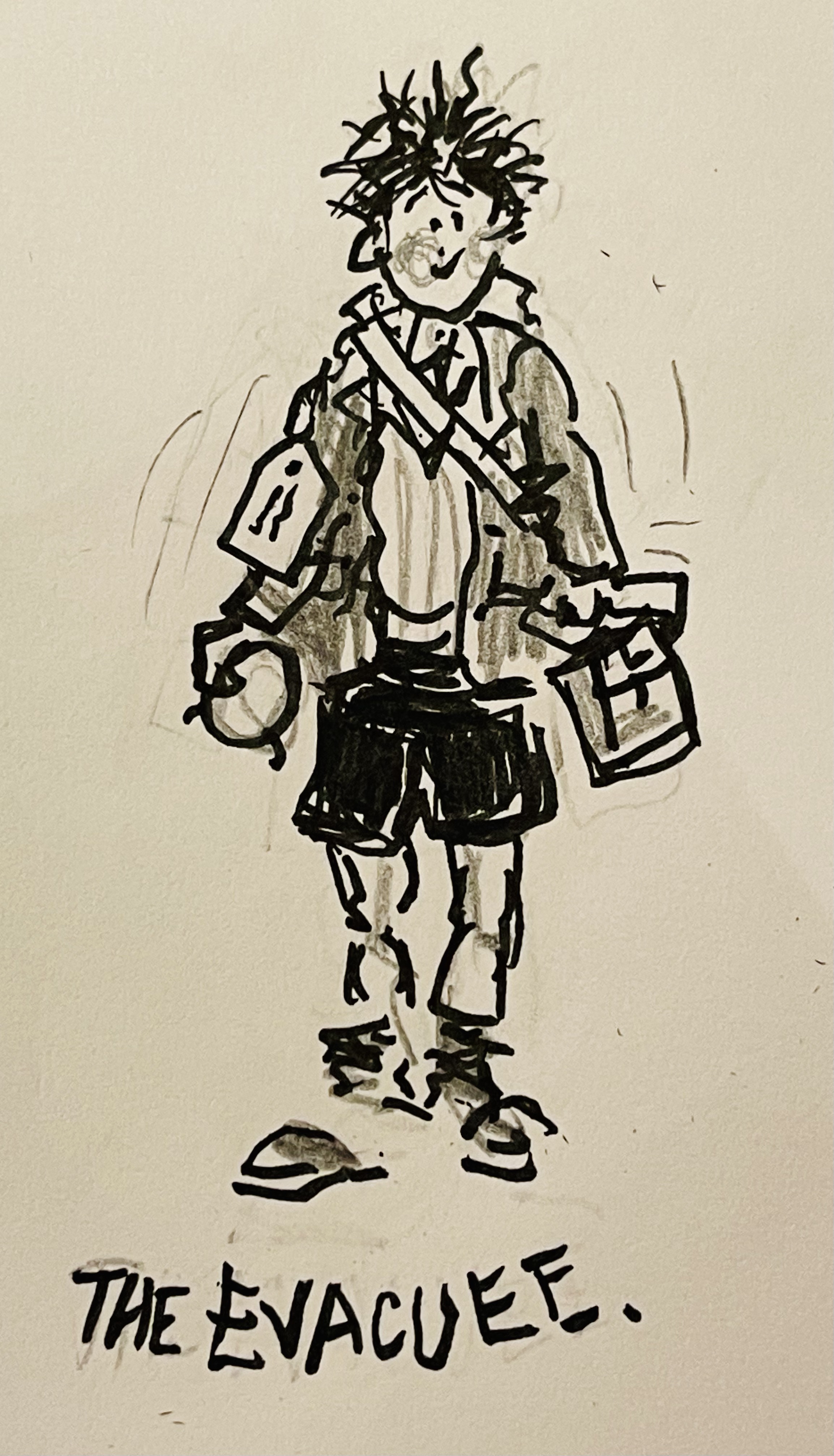
Within a few days we were all given little square cardboard boxes containing a gas mask and shown how to put them on. Can still remember the strange rubbery smell when wearing it. Was told to never leave home without it! But was never really told why! Looking back, have a feeling that our teachers didn’t really know either. Then within a short time nearly all our male teachers were called up into the armed forces.

Rationing then came in with ration books being issued, only allowing us so much food, and to us kids utter indignation we had sweet ration books of all things! We seemed to live on tinned food, God bless Heinz Baked Beans, and tinned salmon. Still like tinned salmon to this day! As a special treat always remember my mother saying ‘We’ll open a nice tin of salmon for tea.’
Then there was rhubarb! Rhubarb seemed to be the only sweet thing we had. So it was rhubarb and custard, rhubarb pie, stewed rhubarb etc etc, in fact, if it was to be sweet, it was Rhubarb! Hate rhubarb to this day!
Fruit like bananas, oranges, grapes and such were completely unheard of. Never saw an orange or banana until after the war. Remember my poor worn out mother walking about two miles to the shops and back every day, then having to queue up in long lines for hours just to get our meagre rations. There were long long queues for everything.
We were encouraged to grow our own food, start allotments and keep chickens!
‘Dig for Victory’ posters were everywhere.
The only coffee we had was out of a bottle, called Camp Coffee. But even that was hard to get!
We used to roast acorns and grind them up to make a kind of substitute coffee.
When looking back, I seemed to live mainly on bread and butter with a smidges of jam.
Used to walk for miles every day to school and back. No lifts with mummy in her car in those days! For all that hardship, reckon we were pretty lean and healthy.

One afternoon a truck arrived delivering a load of heavy corrugated sheets of steel in various shapes and sizes plus a bag of big nuts and bolts. The Anderson air raid shelter had arrived. There was also a stirrup pump and bucket included with the same delivery. This was for putting out incendiary bomb fires, but with no instructions, not that we knew anything about incendiary bombs! Evidently these were bombs which came down and caused fires. The air raid shelter was a self assembly do it yourself job. Having to dig your own big square hole in the garden, as deep as you could. Then lower, assemble and bolt together the heavy sheets of corrugated into the hole. Then cover the whole thing with a thick layer of earth. Easier said than done! Never ever complain about having to assemble anything from IKEA!
Dad and I struggled for days with the thing. First the holes didn’t line up for the big bolts so we had to bash them through with a big hammer. In the end with all the neighbours having the same problems, we all began to work together as a team to get the shelters in. Then we soon found out that it was a clay area. The hole in the garden we were digging kept on filling with water as the layer of clay beneath wouldn’t let the water soak through.
So our shelter, just like everyone else’s was always knee deep in water. Dad having to build the bunks above the water level.


Within a couple of weeks or so of the War being declared, we were all called into the assembly hall at school to be told that next Tuesday we were all going away to live at the seaside as a kind of holiday. We were to be evacuated!
But again never told why!
Remember us all lined up on Croydon railway station platform, all given an apple, and having a big label pinned on us with a big safety pin, and all with the proverbial gas mask in the little cardboard box hanging from our shoulders, with tearful parents seeing us off.
Us boys weren’t tearful in the slightest, as although not having a clue to where this seaside place was going to be, it was to be the seaside! That was good enough for us, wherever it was!
We ended up in Brighton of all places. I was jubilant as liked dear old Brighton.

Me and my mate were billeted at a little terraced house in Over Street. Soon to find out that it was famous for the Over Street trunk Murders. Where women’s mutilated remains were found in travelling trunks left around the country. The actual house where these gruesome murders took place being only two down from us.
We became the celebs of all the evacuees in Brighton with living in such an infamous gruesome place.
The people we were billeted with were very kind but quite odd and scruffy. Bit on the arty side. We were given a completely free rein and lived mainly on bread and jam. When my mother came to visit she was appalled. Especially as I didn’t have to have baths and things, which suited me down to the ground.
Loved those days in Brighton. Spent most of the time fishing off the end of a stone pier right next to the famous Palace Pier. But alas, our stay in Brighton was short lived as the government in their wisdom decided that Brighton might not be a save location for evacuees. So we all had to pack up and leave on a slow railway journey which seemed to take all day to sunny Devon. To a village called Braunton near Barnstable. I was billeted with a lovely family called the Fry’s who had a son of my age called Freddy. We were in a cottage up a windy lane right next to a farm. Have fond memories of taking a big pot jug to the farm every morning for warm milk straight from the cow. Young Freddy showed me a lot about country living with the two of us always up in the hills and woods at the back of the cottage.
They had a family friend, an old Mr Chugg who had a West Coast trading schooner moored in a creek called Vellator near the village. Seemed too good to be true with him having a name like Mr Chugg and at the same time owning a big old sailing boat which had an engine which actually went chug chug chug. But that really was his name, and a great character he was too!
Spent a lot of my time hanging about on Mr Chuggs boat. Just loved the old thing. Was lucky enough to do a trip with him across the Bristol Channel to Port Talbot in South Wales, calling in on Lundy Island which seemed to be half way across. That voyage seems to have stayed indelible in my mind and possibly was the trigger which gave me a lifelong love of sailing boats and the sea.

I fell madly in love, or maybe infatuated, with an evacuee girl at the same school in Braunton. My first true love! To my young eye she was just the most devastatingly beautiful creature on this earth. Ash blonde, tall, skin like a peach, and the most heavenly blue eyes. Her name was Jennifer. Just the sound of her name was enough to send me into raptures. The problem was that she was quite aloof, especially towards me. It was as if I didn’t even exist in her beautiful blue eyes, even though I did everything possible to allure her attention. But no way, not even the tiniest flicker of encouragement. It hurt so much.
As nothing seemed to be happening with the war and a number of evacuees were returning home, my mother decided that I should come home and she came to collect me.
I was devastated thinking that I would never ever see this love of my life girl again, as Evesham where she lived was miles away from Croydon. It was also sad to be leaving the dear Fry family and young Freddy, not forgetting Mr Chuggs boat!

That long journey home was heart-wrenching and seemed to go on for ever, taking nearly all day on a Royal Blue motor coach which seemed to go no faster than twenty miles per hour and stopping in every town. Every single mile so agonisingly further away from the sweetheart of my dreams. It was agonising.

Only a few years back I was driving through Evesham and thoughts turned to this first young love of my life, the beautiful Jennifer.
It crossed the mind…Shall I try and look her up, just for old times sake! Then it struck me that she would be ninety, with horrible wrinkly skin and grey hair. If still alive! So hard to believe this could happen to that beautiful young thing. Age is so cruel. Decided to give it a miss!


Image

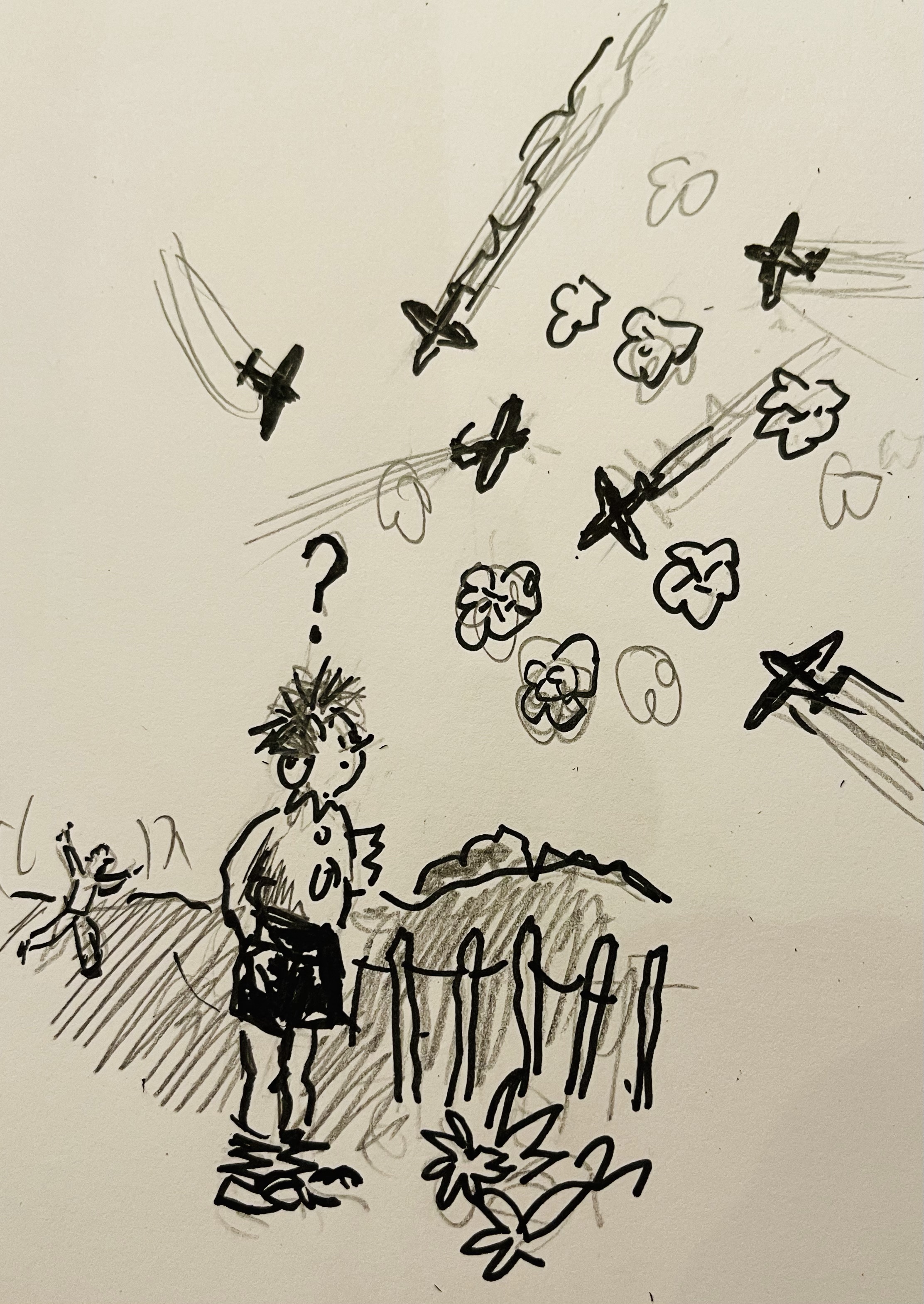
One afternoon, not long after arriving back home in Croydon. I was at the bottom of the garden when a lot of white puffs started appearing in the sky, followed by bangs. Then swarms of aircraft started appearing as if flying round in circles, some chasing one another, just like a swarm of bees.To my disbelief some started coming down in flames. Although a little frightened, was more mesmerised at actually seeing all this in front of my very eyes.
My father came running down the garden, grabbed be and bundled me back into the house. Evidently it was the German Luftwaffe on a softening up mission to put out the RAF fighter stations of nearby Biggin Hill, Kenley and Croydon, to clear the path for the oncoming massive bombing raids on London. The Battle of Britain!
Within a couple of days of seeing those white puffs in the sky, which evidently were our own exploding ack ack shells, the intense bombing raids started in earnest, night after night with the dreary wailing sound of the air raid sirens at every dusk. The nightly raids going on without a break for eight months, killing over forty three thousand innocent civilians.
We used to trudge down to the end of garden with our blankets and stuff to lie all night in our bunks just above the water line in our cold Anderson shelter. Hot soup out of thermos flasks and a tiny resemblance of warmth from the Valor paraffin heater which seemed to create more condensation than heat.

It must have been a most terrifying time for my parents to hear those bombs coming down. My poor mother had constant diarrhoea because of her fear. She used to wait for a lull between the waves of bombers coming over to allow her to climb out of the shelter to relieve herself in the garden. There were pools of mothers poo all over the garden. Not a nice thing to mention, but I think it helps to illustrate the dire times we were living through. To us kids it was more of an adventure, especially going shrapnel hunting in the mornings and looking to see which houses had been bombed, and praying that our school would be bombed!
The first real shock was when our corner sweet shop was completely flattened by a bomb. Dear old Mrs Ellesbury was blown to bits and they found part of her head yards down the road just past our shop, with her grey hair they thought at first it was a dead dog. She was a kindly old soul, who with a wink would always drop a few more sweets on the scales than our allotted ration of two ounces.
Think we kids were more concerned about the loss of the sweet shop than poor old Mrs Ellesbury.

We got to know how dangerous a bomb coming down would be from its sound. If it gave a shrill whistling sound and stayed that way, reasonably safe.
If the whistling sound turned into a whooshing sound, then get heads down. But if the whooshing sound died to nothing, lie flat in with arms over the head. Even in the water at the bottom of the shelter! It was as bad as that!
One of my best pals, who I’d only been swopping comics with that very morning, together with his mum dad and dog, were blown to bits with a direct hit on their shelter which was only two gardens down from us. They never found a trace of their bodies.
Bombs did odd things with their blasts. The house and workshop next door to the direct hit, owned by Mr Hudson the specialist cycle maker was hardly touched, yet it took the side wall and part of the roof of our house away! So we had no kitchen.

That direct hit and the loss of my pal made me for the first time frightened when the bombs were coming down..

An army dispatch rider was blown off his bike and killed by the blast of a bomb a couple of streets along. It became the macabre thing to look up at the side of this building to see the blood splattered silhouette of his body on the brickwork.


Lines of troops were constantly on the move, always in single file keeping well to the side of the road and close in to the buildings. We were instructed to never lock the front door as they could dive into the safety of the shop from the exposed street if the German fighter planes dived down and straffed them with machine gun fire, which often happened.
I had a few German bullets in my collection of shrapnel and stuff.

One bit of an uplift in all that gloom was when Jack Warner, the big star of the day, famous in later years as Dixon of Dock Green, did a Blue Pencil promotion at Kennards department store in Croydon.
He would walk round what was left of the store with a big blue pencil. Everything he marked with it would be reduced to half price.
He even marked my hand! I was catapulted into a world of fame and stardom to have his mark on my hand. To my mothers disgust I adamantly refused to wash that hand for weeks!
Oddly enough in later years when living on a boat on the Thames, got to know Jack Warners two delightful sisters. Elsie and Doris Waters. Also living on a boat on Eeel Pie Island.

The first of the doodle bugs then started to happen. These were pilotless aircraft with a bomb in the nose. You could hear them approaching by the sound of their engine which had a peculiar stuttering sound. Praying that it would pass over. If the engine suddenly stopped it would then dive to the ground obliterating everything before it. I remember you only had seconds to run for cover. They were terrifying as they were then coming in droves by day, whilst we were still being bombed through night.
Worst was to come was with the V2 Rockets. These were the silent killers! The first you knew of it was the deafening explosion and the horrific devastation these things caused. They were terrifying as you just had no warning. Nobody really wanted to leave the comparative safety of the air raid shelter. We became a kind of subterranean society when those V2 rockets were coming over thick and fast.

With the house now little more than a shell with only half a roof and two barely habitable rooms with no windows and with no gas or electricity, it was so cold and unbearable with all the cooking having to be done outside on a paraffin stove. With my dad now away on essential work, it was wisely decided that mother and me should travel North to stay with an uncle and aunt near Manchester and be away from the awful bombing, which thankfully stopped within a few weeks of us leaving Croydon.
We saw little of my dad during this time as he was drafted on essential work with a company called the Simon Engineering company and associated company Simon Calves. I now understand they were working on the concept for the Mullberry Harbour.


In the North I was still having problems with school. The only subject I seemed to excel in was art and encouraged by my very understanding art teacher, a Mrs Pritchard, bless her, I sat the exam to go to Art School and passed, but my parents wouldn’t let me go, believing that I would just swan around. In retrospect I think they were short of money and going to Art School would have entailed the costs of school uniform plus artists materials etc. Anyway I suspect money was at the back of their decision.
With the war still on and most of the male teachers in the armed forces the school admin was virtually none existent , so I played wag, as most of us did.
Two of us got an unofficial job in the Lion House at Belle Vue Zoo in Manchester, as my friends uncle was the lion keeper.
A friendly man called Mr Reeves. We used to help cut up big sides horse meat with blue dye all over it, marking it unfit for human consumption. This was cut in portions for the lions and with the rest we’d make a stew for the bears. Loved working with the animals, especially a Tigon they had at the time called Maud. A lovely gentle creature, half lion and half tiger. She was a creamy colour with the very faint, hardly to be noticed stripes of the tiger. There are both Ligers and Tigons, according to whether the father was a Lion or a Tiger. Can’t remember now which way round it was for Maud, but she was classified as a Tigon.
She got to recognise me, and as soon as I entered the Lion House she would know. At the back of the cages there was passage with big levers for each cage to open a smaller cage for the lion to go into when cleaning out the main cage. When in the small cage Maud used to lie right against the bars so I could stroke her ears and back, she actually used to purr. She once put her big paw down on my hand with now claws evident. I realise now how stupid this was to have my hand in her cage, but I really got attached to that dear poor caged animal. Mr Reeves the keeper who knew his Lions inside and out, was convinced that Maud had formed a genuine attachment and doubted that she would have been aggressive. Although he always warned that we should never ever forget that these are big wild animals which can kill! During the time at the zoo I got friendly with the zoos director and zoologist, Gerald Iles, a most interesting man. Did quite a few drawings for him. He also had a big soft spot for Maud the Tigon.
When my mother eventually twigged that I hadn’t been going to school she had me in front of the head master. He was most amused that I’d been a lion keeper and told my mother with a twinkle in his eye that she had a most ingenious and adventurous son who would probably go a long way. She was not amused.
My unofficial time at Belle Vue zoo and the connection with Gerald Illes helped me enormously when later I got a job with Sir Robert Fosset’s travelling circus.


When I left School at fourteen which was the norm in those days, my mother insisted on sending me to a private boys school, which you could term a Public School, which was right out in the wilds of nowhere as a live in boarder. Absolutely loathed it, especially the prefects who were like self appointed gods. Once I got settled in and had began to learn all the ropes for survival, got friendly with another boarder called Botril. He knew all the tricks. There was a girls boarding school just up the hill and he had a supposed girl friend there.
The girls in her dorm were having a little unofficial birthday party after lights out with a few bottles of cider they had sneaked in, and Botril, me and another male boarder, forgotten his name, were invited. The girls were going to leave a window open for us.
The matron must have either been tipped off or had heard the noise, She came in and caught us. It was all completely innocent stuff. Really! Anyway, we were up before the head and immediately expelled! Think mainly because of pressure from the parents at the girls school. I was absolutely delighted, my mother absolutely aghast, and my dad highly amused.

Not to be deterred, my dear mother who had friends with an accountancy firm, arranged that I could start work with them as a kind of trainee to become articled as an accountant etc.
A respectable profession befitting our family, in my mothers eyes.
But certainly not mine. I rebelled refusing point blank. An Accountant! No way!

Luckily Sir Robert Fossett’s Travelling Circus was in town and I had got friendly with one or two of the circus lads. Evidently there was a job going for a general hand. No questioned asked in those days, and I got the job especially when I told them that had worked in the lion house at Belle Vue zoo and knew Gerald Illes.
That night packed my bag with the unofficial help of my dad, left a note for my mum saying was going to seek my fortune, and not to worry. Then out of the bedroom window to join the lads at the circus, who’d just downed the big top and packed up with everything ready for the circus to be off at the crack of dawn the next morning to the next destination, which was Preston.
They were wonderful days, but hard work, especially erecting that massive Big Top which was an absolute art. Having to climb ropes and things, and surprisingly, it was even harder getting it down at night. I also revelled in the travelling to locations all over the country, generally a couple of weeks before the circus was to arrive, putting posters up and distributing promotional stuff. Helped a lot with all the animals, and contrary to public opinion, circus people in general really cared for their animals. This circus certainly did!
At the end of the second season and after making so many wonderful circus friends, the salt of the earth, most of us young lads had to leave for the winter to find other work as the circus went into winter retirement.

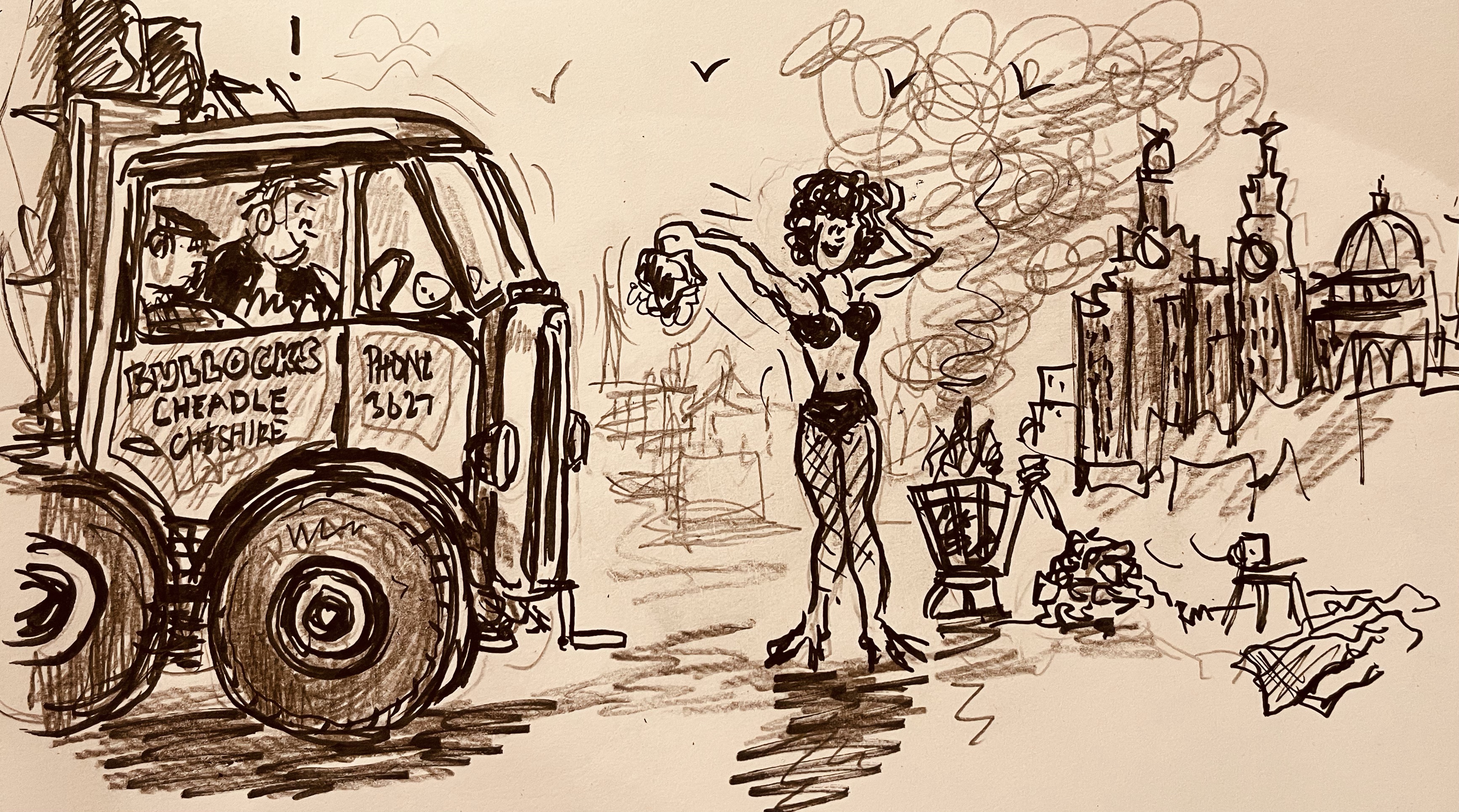
Still wanting an outside travelling job, I became a lorry drivers mate with a heavy haulage company. Bullocks of Cheadle in Cheshire.
Trucks in those days used to pull trailers and the mates job was primarily to look after the trailer and control its brake, and of course the loading and unloading, plus sheeting and roping up.
In my case, I was assigned to an ancient eight wheeler AEC Mammoth Major, heavy truck with an ageing driver called Jock. It was mainly working the Liverpool, London and Glasgow docks, delivering goods straight off the ships to locations the length and breadth of the British isles.
It was this job which gave me a great lasting love for Liverpool and its Scouser people.
As a lanky impressionable teenager, I found Liverpool, its docks and its infamous Dock Road quite something else!


At the time Liverpool was one of the most important ports in the world.
A most wondrous place, teeming with every form of human activity, and enriched by that special Scouse humour.
It was that dock road which particularly intrigued me. An absolute bumper adventure book to my young eyes for every single one of its seven miles.
Used to have sneaky rides on the then Liverpools famous overhead railway. Sadly long gone!
It was an overhead electric railway on a raised gantry running from Liverpool to Southport, similar to the overhead one in Chicago. It ran high up alongside the dock road, overlooking the docks. From up there were magnificent close up views of what must have been the hundreds of ships in those docks. For me conjuring up visions of far off exotic places. Which never helped my wanderlust young mind.
Back down at street level below that railway gantry and next to the busy Dock Road there were bustling little chuffing steam locomotives hauling goods of every description. Their constant clanging bells were very much the Liverpool dock sound.
Sentinel steam wagons were also everywhere with their clouds of steam, weaving in and out of the various dock gates, mainly carrying sacks of brown sugar to the large Tate and Lyle refinery.
Little noisy Lister three wheel articulated trucks whizzing here and there, plus the hundreds of big trucks from every corner of the UK being loaded or unloaded by myriad of overhead cranes high up above the moored ships. The place was like a giant ants nest of activity.
I mustn’t forget to mention the evocative slow clip clop sounds of those lovely big hard working cart horses with their furry hoofs as they plodded along hauling heavy wooden wagons stacked high with goods of every description. Their drivers, often with a sack over their stooped shoulders, delivering to the myriad of old warehouses along the narrow cobbled streets of the port area.
At the time there were hundreds of these big and gentle animals clip clopping around Liverpool, and of course most of the major cities of the UK.
Within a few years they were all gone! Often wonder what happened to all those faithful and hard working animals. Dread to think. All in the name of progress!

So with Jock and me in our eight wheeler truck having just dropped a load off at Brunswick dock, we were now heading north along the dock road, making for Canada dock and the government agency for a return load, often to join a long long line of trucks waiting for loads and often a long wait. Sometimes sleeping overnight in the cab. If a very long wait, we’d sometimes walk along to the Pier Head and catch one of those wonderful Mersey Ferries, often the Royal Iris or Royal Daffodil, preferably to New Brighton and back with that bracing Irish Sea breeze in our faces. Finishing off with fish and chips in a favourite Dock Road chippy.

Our return loads were sometimes bales of cotton from Egypt or America, destined for the magnificent big cotton mills of Lancashire which were still operating in those days. King Cotton still prevailed! Cotton bales meant a lot of specialised loading, which I became a bit of dab hand at. They were high wobbly and precarious loads which demanded a very precise way of loading, sheeting up and tying down, plus with the driving having to be careful, especially when going round corners too fast.
We also had loads of large metal ingots going to Sheffield and various destinations. This was heavy and very dirty laborious work as each ingot had to be carefully loaded by hand.
There was also lots unknown stuff in large crates going to wherever, never itemised on the loading bills. We never asked questions!
Not forgetting the crates of perishable fruit and fish to be rushed to whichever market by early morning!
Whatever, or wherever too, we’d load it and take it!
Sometimes snowed up in winter at the infamous Jungle Cafe on Shap Fell up in Cumberland, might have been known as Westmorland back in those days.
Having to run across fields with a bucket to get water from a stream with the truck boiling up trying to haul a heavy load up the long and arduous Shap Fell. All in a days work.
Heating in trucks hadn’t even been thought of in those days, so it was loads of blankets and cuddling up to the warm engine casing, and if sleeping over night in the cab, often waking up with ice on the inside the widows or little icicles which had formed on the cabs metal roof. They were tough days, but loved them, and always looked forward to those frequent trips up to Bonnie Scotland and Glasgow docks.
On those trips we always had overnight digs, as we called them, at Mrs Duncans guest house in the pretty little village of Crawford nestled amongst the hills near the source of the river Clyde before reaching Glasgow.
Think it was through Mrs Duncan that have a penchant for steak and kidney pie, as she made a most sumptuous one with thick gravy. My stomach used to rumble with the very thought of her pie as soon as crossing the border into Scotland at Gretna Green.
And with Jock being a true Scot we’d both sing at the top of our voices ‘If you take high the road and I take the low road, I´ll be in Scotland before you.` We always had to stop for Haggis and chips at a cafe he knew in Gretna. He loved his Scotland. A true canny Scot and a mean bugger with it. But I adored the man who was like a second father.


The worst load we ever carried was a bit of a quicky! A favour to the government agency who allocated the return loads. A scratch your back if you scratch mine job!…According to Jock it was important that we kept in with them.
It was a get to a certain dock and a docked ship as quickly as possible.
I think a ship was from Cork in Ireland. It was to unload crates of live little squealing pigs. We hastily delivered these poor little pink creatures to big abattoir in Liverpool. Hated it and abattoirs and ever since. Those poor little innocent baby pigs taken from their mothers for slaughter, and we were part of it! Troubled the mind for years.. Even think about it to this day.
Found out they were destined for a gourmet food agency in Paris for the suckling pig market.

Although the war was over with Germany it was still on going with Japan. Food was scarce as rationing was still in operation. So when loading at the docks where hessian sacks of brown sugar were being unloaded from the ships for Tate and Lyle, the crane driver would invariably give us a knowing wink and accidentally drop a sack, which we’d quickly stash away under the spare wheel. Always worth a packet of Woodbines.
The same when carrying tea in those wooden tea chests of the day. On the journey back we’d find a quiet spot and bore a hole up through the trucks wooden flat into the tea chest and fill of couple of buckets. We always carried a handy brace and bit! We were exceedingly popular at home.
Remember a truck carrying live chickens in crates on the Dock Road being in an accident and shedding its load of crates of live chickens, with hundreds of squawking chickens running around amongst a clouds of feathers.
People were appearing from out of nowhere, grabbing them and pulling their necks on the spot then quickly disappearing . Even an innocent looking old lady pushing a pram grabbed some chickens, maybe three of four, can’t remember properly, but vividly remember her with a pram full of squawking chickens hobbling off and disappearing down a side street.
It was a raw time where anything goes, especially where food was concerned, and specially on that dock road in Liverpool!

We often delivered heavy oil drilling machinery to Liverpool docks, destined for places like Basra, Baghdad, Kuwat etc. from the Oil Well Engineering Company based at Cheadle Heath near Stockport. A company which specialised in manufacturing heavy oil drilling equipment.
We were witnessing the very birth of the Middle East oil industry, thus making those hitherto poor countries so rich, including their fat Sheiks!
They were extremely heavy and exacting loads not helped by the ageing old steam crane, which used to judder and strain when loading, with a crane driver who looked a hundred. He probably came with the ancient steam crane when it was delivered new. Used to have nightmares when standing on the trucks flat trying to guide that heavy machinery down, precariously suspended at the end of that cranes juddering cable.

That Dock road was quite unique, because if you were a blind man you would have a pretty good idea of where you were because of the different smells….or in my book, the dock road heady aromas. There was a different dock smell every quarter of a mile.
The thick sweet smell of sugar near Canada Dock coming from big mounds of brown sugar at Tate and Lyle’s. Or the heady smell of tobacco stored by the ton in the massive bonded warehouse at Stanley Dock, reputed to be the biggest brick building in the world. Might still be!
This is where the Leeds Liverpool canal enters into the dock system. Part of a network of waterways covering most of England and Wales. We used to see lines of these colourful narrowboats with their folk all waiting to be loaded up and taken by waterway to places as far away as Gloucester, Goole, Oxford or Bradford.


Back to the smells of the dock road. Was digressing!!
The smell of barley and oats and stuff at Bibby’s the provender people.Then soap powder, think Persil or something like that as you pass Crossfields soap works. Nuts and chocolate….and even cotton near Canada Dock. Those raw cotton bales have a strong and distinctive oily smell.
Those different smells go on and on and right to Langton dock. ..and some not so exotic! Can’t remember them all now or the exact locations, but at the time I knew every single one, so if in a pea soup fog we could traverse those docks in the truck with me just sniffing through the window. Jock was not in the slightest impressed. Commenting that all he could ever smell was the fish and chip shops, and they were frequent!

Then there were the famous Dock Road pubs. In those days there seemed to be one on every street corner, and they were proper pubs with such evocative names like ‘The Baltic Fleet, The Indian Princess, The Coburg, The Queen of Beringaria, The Trawler, The Bramley Moor, etc etc. Sadly nearly all now gone! The Liverpool dockside pubs were notorious!
It was like Vaudeville for length of the road in those days, as many pubs had live street performers. Singers, jugglers, musicians even including a lady with a harp. No wonder they say the Liverpool Sound started on the Dock Road long before the Beatles!
At one pub, a well made tattooed lady in just a skimpy imitation leopard skin leotard with enormous boobs would split a kerb stone in half with a sledge hammer. The kerb stone being on the bare chest of a man lying on the pavement. This thin and pale looking man, her partner, not looking the picture of health would then get up and go round with his cap, then quickly into the pub for a pint.
For some odd reason, that ladies tattooed boobs always stuck out prominently in my young mind!

At another pub they had erected a high wire stretching across the road to the Dock wall. A pretty young oriental looking girl in tights would tie rope walk across holding a long pole.
We never dared to watch!
Think the police eventually made them take it down as it was causing enormous traffic jams.
There was every kind of performing shenanigan going on, on virtually every street corner where there was a pub.
In many ways it was better entertainment than the Golden Mile in Blackpool.

Chesters famous fighting beer, think it was Chesters, was on tap in some pubs, and a few of them held boxing contests where customer volunteers were invited to fight some local bruiser. For some reason Chesters beer, after few pints conveniently seemed to put the punters into a fighting mood. Always crowds at these pubs, plus blood and ambulances.
Some years later, think it was Whitbread, bought Chesters Brewery in Salford and built a brand new brewery with all new shiny stainless steel brewing equipment.
For some strange reason Chesters famous fighting beer seemed to suddenly lose its Mo Jo and fighting spirit, and sales dropped considerably.
Whitbread said that they used exactly the same ingredients and brewing methods for the fighting beer, believing the missing ingredient which created that urge to fight was some wild bug living in the old wooden mash tuns. A beer legend gone forever. How true this is I’m not sure, but it was the story put about.


Image

There used to be some government subsidised canteens for the dockers and truck drivers. Suspect they were subsidised as they certainly had that austere government feel about them. Think they were called ´British Restaurants´ or something like that.
These places were always full to capacity, although the food was bland, with memories of school dinners, and that boiled cabbage smell!
They always gave big helpings and it was dirt cheap.
Particularly remembered the beads of condensation which gathered on the steel framework above, with continual drips, as doubt if the place was insulated.
With absolute horror a big drip fell into my soup with a big plopping sound. Nearly threw up on the spot. Although always pretended to be tough guy, was quite squeamish about certain things. That was the last time in one of those places, thankfully Jock agreed so it was good old fish and chips thereafter. When you think about it, fish and chips were the first take away ready meals!

My adolescent mind was always intrigued by the ladies of the night, as they were politely referred to on that Dock Road, although many of them were well in evidence during the day.
In winter they used to light fires on street corners to keep warm. There were certain street corners or pubs where you could always find them.
Jock was a bit holier than thou about these things, which on looking back was probably a good thing.
There were ladies of every kind, according to your taste.
One scantily dressed woman used to hold her knickers up, inviting us to smell them as we drove past. Think it was the cheapest item on her menu of services, chalked up on a blackboard.
A knicker sniff was 2/6 Two shillings and sixpence. Think the most popular service was a quick blow job in the trucks cab.
There was a handy narrow street nearby known by the drivers as Gobble lane.

Nothing was never a surprise in Liverpool dockland. There used to be a little guy wearing a top hat peddling a three wheeled bike with a kind of box on the front with chimney sticking out of it, often belching out black smoke. He had a little coal stove going in selling hot pigs trotters or black puddings with mustard and sometimes things he called savoury ducks. Jock loved the pigs trotters, I used to get out of the cab when he ate one.
Another guy always dressed in what we used to call a Crombie overcoat, as Jock always remarked, the uniform of a spiv! used to drive around in a big old blue furniture van selling genuine stolen gear. Used to have it in big lettering on the side of the van. There used to be queues buying his stuff, even the dock police! Watches, bikes canteens of cutlery, always something different. I bought one of his canteens of cutlery in a mahogany case for my mum.

Near Canada Dock there was always a red Indian gentleman, complete with all the feathers and stuff with a big teepe (Indian tent) erected on the pavement with his shapely squaw sitting inside. Think he was a Red Indian, but he did have a strong Scouse accent. The squaw told fortunes. There was always a queue of drivers waiting for their fortunes to be read. Jock reckoned it was nothing to do with fortunes, but wouldn’t elaborate on the subject.

At the southern end of the dock road, just up a little hill was China Town, reputed to be the first in Britain. Now this was only for the brave territory. We never ventured up there, but there were many tales to tell!

The Liverpool Dock road, back during those wild west frontier days of the forties, was to me, the most exciting, bustling and colourful seven miles on this earth. Sadly today, the road is still there but its whole colourful character and personality completely gone. Just a dreary road running next to the never ending dock walls. Sad.
The river Mersey which used be full of ships, now not a ship to be seen except for the ferries. Half the docks have been reclaimed for land and office buildings and the those remaining looking pitifully empty and sad. Hard to believe this was once one of the most important seaports of the world and the gateway to America. Thank goodness for the Albert dock which has been preserved, often with sailing ships and interesting vessels in attendance. Plus shops and restaurants and such, still giving Liverpool that nautical flavour and the great city it is.


My dad had a yacht of sorts. A converted ships lifeboat he’d bought in Deganwy North Wales. He added a small cabin with a couple bunks, plus rigging it with a simple Gunter sailing rig. In his eyes it was a yacht. In fact not many people had a yacht in those days, and we were looked upon with some esteem.
He had decided to act out his dream of circumnavigating the British Isles. After all it was a lifeboat hull designed to take the worst of seas.
My mother thought he was mad, but ever adventurous dad was determined. He’d done a bit of try out sailing with it in the Conway and Deganwy estuary, and after making a few modifications, including fitting a modified Morris car engine. Having read every conceivable book he could get his hands on about ocean voyaging. He was ready to join the ranks of Ocean sailors.
Poor dad , if had been given the opportunity, he would have lived the life of an adventurer. But like so many of that period there were just no opportunities for the ordinary working man. It was only for the privileged classes.
So this was his chance, to circumnavigate the British Isles and I was to join him as first mate. Wo Ho!
We set off on one miserable wet Saturday morning from Deganwy in North Wales. My mother was there with a carrier bag of food to see us off. I’m sure thinking she’d never ever see us again. We set a course for the Isle of Man, but as the very light wind was on the nose we motored as best we could with the old converted Morris car engine, which would never start and kept on sputtering and stopping. With the little wind there was, we finally made the little port of Peel in the early hours of the next morning.

I was beginning to wonder if I was really into this so called sailing business as it proved to be a bit boring. The sky was grey the sea was grey and as flat as a pancake with hardly a breath of wind. All we had done all day was just sit huddled in the little cockpit doing nothing except for listening to that noisy smelly engine, expecting it to splutter to a stop at any minute.
The next leg was to Scotlands little harbour of Port Patrick on the Mull of Galloway, which we made the next day, actually doing a bit of real sailing which was marginally faster and more interesting than using that noisy smelly engine.
As we progress further north the wind got up, the sky changed to, blue with scudding white clouds and the now lively sea which changed from that dull grey to green.
‘Sunshine’ the name of dads little converted lifeboat began to be a proper yacht. With a fair breeze we were now healing right over on our beam ends and seemed to be charging through that water at a fair rate of knots actually leaving a white wake. It was exhilarating stuff. Yes, I liked sailing!
As we ventured North, we found the little Scottish ports to be welcoming, and the scenery breath taking. We had now got into a proper on-board routine. Reckoned I had become a sailor!

We were trying to round Ardnamurchan point. Reputed to be the most westerly point of mainland Scotland. For some reason, which I can’t remember, we were later than had planned and it was already going dark. Remember that Dad was getting anxious as we were sailing as close the wind a possible. He tried to come about and go on another tack but the bow for some reason kept on coming back on the old tack. As well as a flooky wind, strong currents seemed to be taking over in what seemed to be a very confused sea. It was now dark, but luckily we could see the lighthouse flashing at the end of the headland, so all we had to do was get round it.
‘Start the engine!’ dad suddenly yelled. It wouldn’t start! Tried and tried, but not a flicker of life. By now I could hear the waves breaking on rocks.
He then barked ‘Quickly, get down below,’ bundling me down into the cabin at the same time thrusting into my hands a mahogany box containing his beloved sextant. ‘Hold on to this’ he yelled.
I knew things were not right, but never expecting what would happen next!
One minute I was in the false security of the cabin, shut away from that cold hostile outside. Then it was if a bomb had exploded beneath my feet. There was an almighty bang and the cabin shuddered with the boat lurching on its side, then another bang and more shuddering. The noise was deafening. Next minute everything seemed to just disintegrate around me, the cabin had disappeared completely and I was sitting in freezing cold crashing waves with planks and bits of wood swirling all around. Our little yacht had hit the rocks and had completely disintegrated.
Dad grabbed me and we managed to clamber up slippery but jagged rocks through the breaking waves to the higher rocks. Remember them having razor sharp barnacles of whatever they were cutting my knees and hands. All Dad said was ‘Have you still got that bloody sextant?’
We could just see through the dark, the planks and bits and pieces of our yacht just floating away.
It was quite surreal as they lit up on that dark sea as the beam of the lighthouse passed over them.
We were both wet through and bloodied after clambering over those jagged rocks. At the top of the rocks and just across a field we found a lane and we walked in the direction of the lighthouse where there was a row of low cottages, thankfully with a light in one of them. The lady had a shock when opening the door and seeing us two. Bless her. She was marvellous.
We finished up in a police station where we managed to get dried out and reasonably cleaned up. Hard to remember the exact details, think we slept somewhere but can’t remember where. The after a couple of days, our trusty old Morris eight car came to collect us. Can’t remember who had driven it.
So that was the start of my sailing career.


Dad wasn’t as upset as I thought he would be, considering the total loss of his beloved boat. No insurance in those days!
It seemed that for a while he’d had his eye on a proper yacht with a good pedigree.
Mother was furious.
It wasn’t long after our shipwreck, that I was dodging waves again.This time on a sailing trip with dad in his new boat. A 26ft proper sailing yacht designed by Maurice Griffiths. She was quite old and looking a bit tired, needing a touch of paint and varnish here and there, but a great improvement on his old converted lifeboat.
Maurice Griffiths was a respected yacht designer, and this was a capable little yacht. It had been owned by a friend of the family who suffered heart problems, and it had been laid up for a number of years, so after an amicable arrangement it changed hands.
On that trip I was given lecture. Basically it was…..If I wasn’t out of overalls by the time I was eighteen, I’d be in them for the rest of my life, and it was time to start thinking seriously about getting into a respectable profession. I remembered thinking, there wasn’t any respectable profession I really wanted to be in. Think it was the ‘respectable’ bit which put me off!
Giving me a knowing look, as if fully understanding what was going on in my mind, he carried on. ‘Look Roger, when I was your age, I was drifting from job to job, generally as a lowly locomotive cleaner up at the engine works in Ashton. It was grandad Sam who gave me the same advice that I’m giving you, and believe me I owe him! You wouldn’t be sailing on this boat with me now if I’d carried on cleaning dirty railway engines.’ He paused with a half smile. ‘Anyway, it would get your mother off my back!’
I gave this getting into a profession advice quite a lot of thinking about, but every profession I could think of seemed as dull as dish water, unless it was an airline pilot or a ships captain or something of that ilk. The only thing I was reasonably good at, at school was drawing and art. Was top of the class for that! So maybe get a job in advertising. After a lot of going into these advertising firms and asking if any jobs going. (You could do that in those days,) finally got a job as a general dogsbody in an advertising agency called Pratt’s.
Well, you have to start at the bottom.
In those days virtually everything was drawn by hand, especially lettering. That headline in any advertisement was always hand drawn by a lettering artist. Seemed a bit tedious and dull to me, and the guys doing it looked dull and tedious.
Quite fancied being a visualiser. Thinking up the ideas and then scribbling them down with a rough layout for an ad.
The agency handled the Shredded Wheat account and I came up with an idea which they actually used!
Went a bit to my head
Especially when my idea started to appear on ads in the national press. Was telling everybody that I was an Ad Man.
Within a short time the first phase of my career as an adman came to an abrupt halt. I was eighteen and called up for National Service.
The first instruction re being called up was receiving a letter stating that had to report on a certain date to an address in Manchester for a medical and assessment etc.
Got A1 for the medical which took less than a few minutes. Then an interview with a most bored looking guy sitting at a little desk in a vast room which seemed to have at least a hundred little desks with interviews going on.
The interview was short and sweet. If remember correctly he asked what I did for a living. Did I have any qualifications etc. What kind of school I went to, and if my parents were still alive!
He then asked which branch of the armed forces did I want to go into which I promptly replied… Royal Navy. Saying had been in the Sea Cadets plus giving a list of, what I thought were extremely convincing reasons including my time at seas with my dad. He just nodded and scribbled something on an official looking piece of paper with my name on the top.

As it was going to be a few weeks before the call up papers came, so decided to clear off for a couple of weeks cycling round the country. Had everything on that bike! Sleeping bag, Primus stove, couple of pans and some tinned stuff plus tin opener, etc etc. The complete independent traveller. Cycled to the Norfolk Broads where an old circus friend lived on a boat. Life was so good on the water at Barton Broad that I was a bit late cycling back home.
My parents were going spare. Evidently my call up papers had arrived over a week ago and I should have reported to a barracks at Aldershot three days ago. That little shit at the interview had put me down for the Army. But that’s another story.

Stacks Image 404
© 2021 Roger Murray